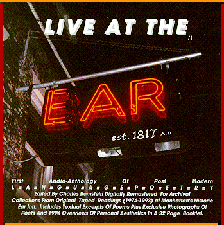
The Ear Inn, a small bar on Spring Street near Tribeca (just before it turns into the Hudson River), has been the home of arguably the best reading series in New York City over the past two decades. Ted Greeenwald and I started the Saturday afternoon series in the Fall of 1978 with a reading by John Ashbery and Michael Lally. Over the many Saturdays that followed, the audience has shifted in size, the PA system has worked and had conked out, the noise from the bar has sometimes become intrusive. But the commitment to a continuing renewal of the art of poetry has never faltered; a commitment, that is, to a spectrum of writing that places its attention primarily on language and ways of making meaning, that takes for granted neither vocabulary, grammar, process, syntax, program, or subject matter – indeed where all these dynamics remain at play. Over the years, the Ear Inn series has been able to retain its vitality because of the energy and judgment of the poets who have curated the program, for sometimes just a month and for sometimes several years; in particular Mitch Highfill, Jeanne Lance, Andrew Levy, Rob Fitterman, Laynie Brown, James Sherry of the Segue Foundation, George Peck of the Ear Inn have all been crucial to keeping the series going. – C.B., New York, January 1994 |
click on speaker icon for streaming.
 |
Susan Howe: I wish I could tenderly
lift from the dark side of history voices that are anonymous, slighted
- inarticulate.
|
 |
Ron Silliman: The
two tables in front were crowded with young men with crew cuts and flat
tops, a little too neat to be skinheads. It turned out that they were
cadets from West Point, sent by an English professor on an assignment
to hear a reading in Manhattan. The Ear Inn, serving beer mid-afternoon,
fit the bill. I couldn't tell what they made of Oz until the line "your
haircut's too political" when
they burst out laughing.
|
 |
Leslie Scalapino in "bum
series" (a
section in the center of the poem, Way) was trying to get a shape or
a sound that's movement in locations, and is also compassion by itself
(objectively) occurring (not imposed) in these locations.
|
 |
Ted Greenwald: one foot in the other world the other foot in the other world
|
 |
Rosmarie Waldrop: Reproduction
of Profiles is a narrative tease using "semantic sliding." I used the
philosopher Ludwig Wittgenstein's phrase in a free, unsystematic way,
sometimes quoting, sometimes letting them spa rk what they would, sometimes
substituting different nouns within a phrase (e.g., his famous anti-metaphysical
statement that "the deepest questions are no questions at all" becomes "You
could prove to me that the deepest rivers are, in fact, no rivers at
all.").
|
 |
Alan Davies: Love is Life Source. Soul is Life Energy Spirit is Life Force.
|
 |
Barrett Watten: Under Erasure was
written
"through" the hiatus of 1989 and argues out the epochal implications
of that end. As with the revised version of Stein's Making of Americans, there
are implications for social communication in a poetics of ellipses,
considering what has been elided (and all the possibility that went with
it), but making use of the ciphers that remain.
|
 |
Erica Hunt: Will there be any room for
the future? A fat future ripe with possibility and potential defeats -
or accident or tedium? We sit down by our relics as the market wars break
out on the streets. We are not prepared to rot, yet we wait as if someone
will fix this for us, wake us in time for breakfast and smiles.
|
 |
Bruce Andrews: Only the pivot, language
locus embodies us bodies imperatively impossible.
|
 |
Hannah Weiner: I am a clairvoyant writer
"all these on my forehead words are seen "SILENT TEACHER now I hear words
even without the phone silent conversations.
|
 |
Steve McCaffery: If the aim of philosophy
is, as Wittgenstein claims, to show the fly the way out of the fly bottle,
then the aim of poetry is to convince the bottle that there is no fly.
|
 |
Ann Lauterbach: Poems intervene or intersect
between telling and told, and are vagrant as such, which gives place to
the Ear, the in. Inward is complex as urban locale; this poem an expansion
whose multiple sources allow curiosity unhindered by answers but determined
by language as that which we hear in the near. In this instance, an homage
to Charles Bernstein, "Shaman of Discourse," who knows the difference
between here or drear.
|


 |
Charles
Bernstein: Poetry
and poetics are part of an exploration not so much of how I can make
words mean something I want to say but rather letting language find
ways of meaning through me. Form is never more than extension of
sound and syntax: the music of poetry is the sound of sense coming
to be in the world.
|
HOW TO ORDER:temporarily unavailable