Feminist Art: A
Reassessment
Introduction
by Susan Bee and Mira Schor
The feminist movement in America of the late 1960s and early 1970s seems to be a particular contentious and problematic part of our history, even among women. It is forgotten or demonized, and yet there are constant efforts to memorialize, revitalize and continue its legacy within new generations of women. For example, a number of events were planned for 2006 to 2007, coordinated under the aegis of the Feminist Art Project, including a number of 35th anniversary exhibitions and celebrations: of Judy Chicago’s Feminist Art Program (FAP) at California State University at Fresno, of the Mary H. Dana Women Artists Series at Rutgers, originated by Joan Snyder, of the exhibition “Where We At,” organized by Faith Ringgold and other African American women artists, of the publication of Linda Nochlin’s signal essay, “Why Have there Been No Great Women Artists?,” of the formation of the landmark women artists cooperative New York gallery, A.I.R, of the Feminist Art Program at CalArts and of the FAP’s 1972 installation project, Womanhouse, followed by the 35th anniversaries of the Women’s Building in Los Angeles, and the Women’s Caucus for the Arts at the College Art Association.
Exhibitions that are part of the Feminist Art Project in 2006 to 2007 include How American Women Artists invented Postmodernism 1970-1975, curated by Judith K. Brodsky and Ferris Olin at Rutgers University, the opening of the Elizabeth A. Sackler Center for Feminist Art at the Brooklyn Museum, Global Feminisms curated by Linda Nochlin and Maura Reilly opening at the Sackler in March, and WACK! Art and the Feminist Revolution, curated by Connie Butler, opening at the Museum of Contemporary Art in Los Angeles and coming to PS.1 in New York next year, One True Thing, curated by Dena Muller at A.I.R. Gallery, From the Inside Out: Feminist Art Then & Now at the Dr. M. T. Geoffrey Yeh Art Gallery at St John's University in Queens, curated by Claudia Sbrissa, Re:Generation, curated by Joan Snyder and her daughter Molly Snyder-Fink, a show of 18 emerging women artists for the 35th Anniversary of the Womens' Artists Series at Douglass College, at Smack Mellon Galleries in Dumbo and The Kentler International Drawing Center in Red Hook, Brooklyn, Women, Art, and Intellect, curated by Leslie King-Hammond, at Ceres Gallery; and also, “The Feminist Future: Theory and Practice in the Visual Arts” a two-day symposium that was at MoMA in January 2007 and a day of panels that are part of the Feminist Art Project at the 2007 CAA Annual Conference in New York in February 2007.
This impressive list is troubled by a number of undercurrents. Many of these are familiar tensions within feminism and the feminist art movement since its early days: tensions over racial representation and the perception of the predominance of heteronormative tendencies, generational tensions and rifts over the social meaning of the word feminism itself: at the MoMA conference one younger woman in the audience described identification with the word feminism as the “kiss of death.” There seems to be a continued disconnect between the current efforts at retrospection, historical reiteration, and recuperation, and the younger generation of women artists, who the older, “70s-era” generation wishes to inspire and also be recognized and honored by.
There is the frustrating reality that once the feminist canon of 70s feminist art was in place, it has been seemingly as fixed as the first (male) art historical canon had been. The efforts to enrich the established history by inserting many artists working inventively and with a feminist agenda of some kind in those years has been frustrated by the general atmosphere of limited commodification of the art market as a whole. The slice of the market and art historical canon pie is ever smaller while the price paid for being a feminist artist has often been substantial, sometimes leading to bitterness. These emotional undercurrents take place against a background of general cultural conservatism and the dominance of market values over social critique and nonconformist collaborative political activism.
Further, adding another archeological layer of forgetfulness, not only are many of the artists whose work was initiated by their generative encounter with early feminist art at the beginning of the movement still excluded from this reinvestigation of the history of that time, but another significant part of the history is also in some obscurity at this time: the intellectualism of psychoanalytic and Marxist-inspired feminist theory that marked the 1980s is also demonized or lost in this generally unintellectual time. Thus the panel that Mira Schor organized for the CAA day of panels on February 17th, 2007– “Life of the Mind, Life of the Market: A Re-evaluation of the Contribution of Theory to Feminist Art from 1980 to 2006” with Mary Kelly and Johanna Burton–will focus on a reevaluation of theoretically inclined intellectualism in a market-driven age.
We organized this M/E/A/N/I/N/G Online Forum precisely because of the contradictory aspects of this renewed interest in feminist art. The many exhibitions and panel discussions on feminist art listed above suggest the desire for a reassessment of the history and the current situation of feminist art and art by women around the world. However, the picture of the art made by women in the 1970s is inevitably partial given the scope of the subject. In proposing this forum to a large spectrum of women artists spanning at least three generations, we wanted to create a situation for reconsideration of 70s feminist art and the 70s in general. The questions we posed were:
Which women artists' work were you particularly interested in during the 1970s? What work were you doing? If you have come of age since the 1970s, what works by women artists of that time or of your generation have been influential for you? What are you doing in your own work that you feel relates to the Feminist Art Movement?
The responses we received span generations between the 1960s and the present. We wish to note that the racial and the gender composition of our respondents reflects those who answered our call for papers, not the much larger group that was invited to participate, a phenomenon also noted by MoMA curator Deborah Wye when the whiteness of the panelists at the MoMA symposium was challenged by audience members. However we are thrilled by the enthusiastic response to our questions and by the responses from the many wonderful women (and one man), who are new or are previous contributors to the M/E/A/N/I/N/G community.
Each person who has responded to our questions has had a personal approach to the questions. The open-endedness of these forums has been one of the characteristics of the M/E/A/N/I/N/G project from its inception in 1986. We hope that this forum gives some sense of the richness of the lived life of feminism in art.
Irina Aristarkhova
There were at least two works by women artists imprinted in my mind in the 1970s and early 1980s. First, Zinaida Serebriakova’s self-portrait of 1909 At the Dressing-Table. This painting was included in textbooks used by all Russian secondary schools. In 2003 a gallery in St. Petersburg, Russia, had a large retrospective of her works, with this image being used on publicity materials, to lure the public to a common image.
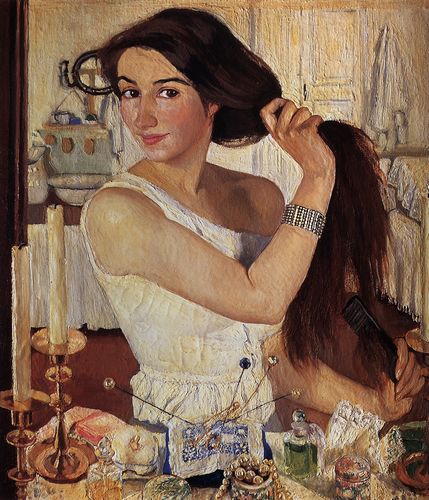
Zinaida Serebriakova’s self-portrait, At the Dressing-Table, 1909.
This work appeared during a period in European history when representational painting was questioned and transformed (early 20th century). The mood was even more serious and melancholic in Russia, where the Silver Age in art and literature was characterized by the dark mysterious poetry of Alexander Blok and the paintings of demons by Michael Vrubel. As one critic writes, this painting was made at a time of “spiritual crisis of Russian intelligentsia, brought about by the failure of the first Russian Revolution [of 1905]; the time of broken dreams, worst disillusionment, and loss of faith in human spirit, spiritual disconnect between dream of wonderful future and reality of everyday life.” As a result, At the Dressing-Table had a miraculous joyful impact during the exhibition in 1910 and Tretyakov Gallery (one of the largest art museums in Russia) acquired it immediately. It was included in a Soviet textbook despite its author leaving Russia in 1924, and probably remains there today.
The second work is of another childhood memory from a textbook. Tatyana Yablonskaya’s “Morning” was as joyful and happy as Serebriakova’s self-portrait. A girl stands in the middle of a sunny room, doing her morning exercise, getting ready for a day where she fulfils an important task of educating herself, discovering her ambition and fulfilling her potential, probably to participate in the building of socialist present and communist future. It was done in 1954, by an artist who was a leader in socialist realism movement, and who, according to her own words, later despised the ‘flat’ quality of the painting. Morning is also in the Tretyakov Gallery, since Yablonskaya was a leading Soviet painter, and many of her works were acquired by major museums. She died in 2005 in Kiev, Ukraine, with an official title of ‘hero of Ukraine,’ serving two terms as a member of Ukrainian parliament, professor, multiple award winner, and her own strongest critic.
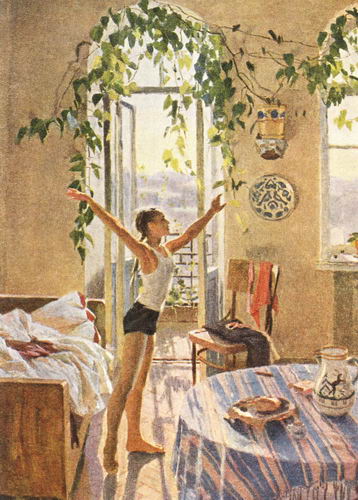
These two works are influential beyond words for generations of Soviet children, they had impact even by just ‘being there’, and it would be interesting to do more research into the history of their inclusion into textbooks, and its (un)expected result. Without doubt, one could charge these paintings’ official inclusion with being straightforward propaganda and brainwashing. However, both women artists, in different times, in different contexts, were painting women and girls as a matter of fact. Painting them happy, joyful and by themselves: it was radical in 1909 and in 1954. It was still surprising in the early 1980s, enough to be remembered till today.
In 1999 I conducted a Feminist Art Workshop at LASALLE-SIA College of the Arts, Singapore, which resulted in a symposium and exhibition called A Self of One’s Own (there is a catalogue and curatorial essay with the same title). Two publications related to feminist art, inspired by the work done in the 1970s were particularly important to my thinking on the subject during that time: The Power of Feminist Art, edited by Norma Broude et al, and Inside the Visible: In, Of, and From the Feminine, edited by Catherine De Zegher. The same year I met Faith Wilding, who has been a constant source of influence and inspiration. At this moment I am writing an essay about work by Mithu Sen, a Delhi-based contemporary artist and poet who makes drawings, installations and objects, and I share her interest in the topics of hospitality and subjectivity.
Thought and creative work are two dangerous activities for a woman, especially as professional lifelong pursuits, as it might change the world and herself. This transformation has been of interest to me, especially as it became a subject of systematic study and collective work within feminist movement.
The Feminist Art Movement had the guts to bring to the mainstream what was considered before at best accidental and at worst plain crazy: a woman artist. And in the process both words “woman” and “artist” are deconstructed and redefined, since they really cannot be together, it is indigestible by Western art history as we know it. Yes, a woman artist is still considered by many just a contradiction in terms, but after the Feminist Art Movement we can laugh at it, since this is exactly our point! Unlike women artists of the past, who were more or less polite comrades, daughters and female companions of men artists, it was a movement made by women for women, no apologies, and it has been changing lives of those women who participated in it. Some of its aspects were at first uncomfortable to me, however, over a year ago I moved to the US, and now I seem to understand better why it was like it was: adamant, angry, and like a hurricane. It was a sense of common purpose when enough is enough to live like a ‘companion species’, and the courage of American women is admirable. It was a desire to shake off entire culture that makes woman-artist an expression, which is still embarrassing to most of my female art students. It is a shared history of Feminist Art Movement that very few generations of women would ever experience in their lives. In my own work today I try to be patient, since what we face everyday – history, art, language – is still largely anti-woman, even anti-ourselves (how else can one explain that possibility to have a woman or non-white president is still a matter of ‘national readiness’?). That is why I am not surprised that “F” word is so disturbing to many students. I noticed in my classes here that it takes a long time to go through the “F” word, while time would be better spent on discussing questions of aesthetics and its relation to space and time, or cultural difference, or poverty and sex-trafficking. While students try to frame me into a kind of "F box," I am trying to develop ways to avoid focusing too much on trying to prove anything to them, and rather move the discussion into direction of works themselves and issues at hand. To enable it, I have been formulating a few strategies for effective pedagogy, and the following is just two examples from those preliminary ideas.
1. Do not demand from a woman artist more than you would do from a male artist or what you see men demand from themselves. RELAX. It’s ok if not every woman artist or woman thinker is perfect (in whatever sense), and you do not have to feel yourself responsible for everything that another woman is doing. Women artists and writers have always done works of various quality and scale, and there is no need to dismiss the whole work as not perfect. Do not try to outsmart yourself all the time with critical rhetoric: it never ends. Learn: there are many women artists of all kinds of media, history, aesthetics, demographics, and cultures. There is no ‘true’ or ‘innocent’ representation / object / process, and making art involves risk and commitment to choice. Not making art, or writing, is not an answer to the fact that anything we make / write is implicated. RELAX. BREATHE. Take your time, wait, suspend judgment. Give yourself time.
2. When a student or a curator asks why to distinguish between women and men artists, or why to have exhibitions based on gender specificity, do not try to give an answer, even if you have ‘the best or right’ answer. Say something like “Why not?. The question itself frames a problem, makes it into a problem. And today to have a question like that is to be, basically, deaf, since Feminist Art Movement produced, discovered, and recorded so many answers! When Freud or whoever else asks “What does a woman want” he is not asking you, woman, he is just talking to another man / himself. There are so many women’s answers out there, those who want, have heard them. Pause for a moment, check if it is a monologue and not a dialogue as you hope. When you are curating an exhibition of women artists or having a book on women artists, or teach a course on women artists, do not start from or end by explaining / justifying ‘why.’ Not only any one of your justifications would seem like putting down other types of work or exhibitions, it also makes it into an issue even before the works themselves are discussed. After the Feminist Art Movement, it is a waste of our time, to move into this direction of justification, at least, from my personal experience of teaching. My position has become: I do not owe an explanation, not to say, justification, to that question. I have more time to show more recent art works, since it has been explained and answered a thousand times already. Thank God for the Feminist Art Movement! We can, hopefully, move on.
Irina Aristarkhova writes on and teaches courses in new media aesthetics, cyberculture, and feminist theory. She is Assistant Professor of Women's Studies and Visual Arts at Pennsylvania State University . She has edited and contributed to, Woman Does Not Exist: Contemporary Studies in Sexual Difference (Syktyvkar University Press, 1999, in Russian), and edited the first Luce Irigaray book in Russian, The Ethics of Sexual Difference (Moscow Art Magazine Publishing House, 2005). She was born in 1969 in Moscow.
Family Trees
I got all my sisters with me.
– Sister Sledge (1979)
In the fall of 1969, after graduating from the bohemian grove of Music and Art High School in New York, I went to Barnard College, then as now an all-women’s college. My college years were set against the background of the raucous student actions against the Vietnam war and the emergence of the black power and gay rights movements. Columbia and Barnard were the focal point of many demonstrations in which I took an active part. It was good time to be at Barnard, since I had the great luck to meet or study with such major feminist thinkers as Catherine Stimpson and Kate Millet. At one point, I applied to major in Women’s Studies but was told that no such interdisciplinary major could be considered (some years later, Barnard did establish a Women’s Studies major).
I had also wanted to major in studio art, but Barnard didn’t countenance that either, so I ended up in Art History. In any case, there were almost no women art teachers at Barnard or Columbia. So I found myself looking outside of the college environment for role models. I had the example of the art and life of my mother, painter Miriam Laufer. In December 1970, I wrote a research paper on women artists in Barnard’s first seminar on women’s history, taught by Annette Baxter. At that time, I could find no reference books, or for that matter just about any information, on the subject. All that was soon to change. A.I.R. Gallery was founded in 1972. Lucy Lippard’s crucial From the Center, Feminist Essays on Women’s Art was published in 1976, and Heresies was founded in 1977. From 1979 to 1980 I worked as an editor for Cynthia Navaretta at Women Artists News, which had started in 1975.
In graduate school at Hunter from 1975 to 1977 there were no women art teachers at all in the department. So once again, I found myself looking to the newly formed feminist galleries, A.I.R. and Soho 20. I went to panels at A.I.R., which were organized by Nancy Spero and other artist members. And I listened to Ana Mendieta, Mary Beth Edelson, and many others talk about their artwork. These were heady experiences for a young artist. I vividly recall a panel at A.I.R. where Rosalind Krauss, my art history professor and thesis advisor at Hunter, and the only woman on the modern art history faculty, denounced feminism. No doubt this paved the way for her rapid ascent into the art establishment.
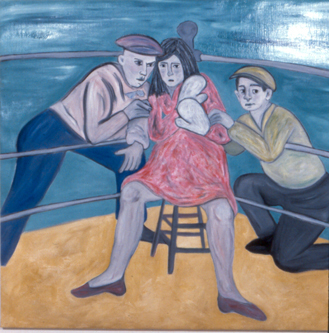
Susan Bee, Doomed to Win, Oil on canvas, 50
x 54", 1983.
Some of the women artists whose work most engaged me in the 1970s were Carolee Schneemann, Hannah Wilke, Louise Bourgeois, Joan Snyder, Pat Steir, Joan Semmel, Joan Jonas, Joyce Kozloff (and the Pattern and Decoration movement), Louisa Chase, Ellen Phelan, Mary Lucier, Joan Snitzer, Lee Sherry, Toni Simon, Eleanor Antin, Howardena Pindell, Alice Neel, Mimi Gross, Alice Aycock, Marcia Hafif, Faith Ringgold, Elizabeth Murray, Eva Hesse, Erika Rothenberg, Dottie Attie, Nancy Spero, and Miriam Schapiro. Well, anyway, those are the artists I most recall now, partly because of my own ongoing relationship with them. I know there were many others whose names I don’t remember or who dropped out of sight. I also mention these names because so much of the Official History of Feminist Art has involved deleting names not authenticated by the feminist and commercial art establishment.
In my student years at Barnard, I did expressionist figurative paintings, influenced, in part, by my mother’s work, as well as cut-up and collaged abstract paintings. I also did whimsical rapidograph fantasy line drawings, especially during my life in the rainforest of British Columbia, where I lived for a year after college with Charles Bernstein. While he wrote poems, I painted and drew – and we both chopped a lot of wood. We also spent a year in Santa Barbara, where I worked in a daycare center by day and painted by night.
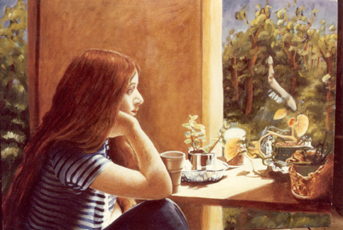
Susan Bee in British Columbia, painting by Toni Simon, 1974.
By 1975, we had moved back to New York. When I started at Hunter’s M.A. program, I was doing large abstract stain paintings like Helen Frankenthaler's. I also did a number of letterist collage works that were published in various small press magazines interested in visual poetry; these works were shown in the U.S. and internationally. At Hunter, due to the overwhelming influence of my Minimalist professors, including Robert Morris, who disliked the colorfulness and expressivity of my paintings, I started to paint in just two colors, blue and white. As much as I liked Morris and some of his work, I didn’t feel he and his very much “fellow” company (Krauss included) allowed much room for students who thought about art differently than they did. Whether or not this is a gender issue remains hard to say; but gender cannot be entirely left out of the equation since it was, at the time, a consciously suppressed term. While at Hunter, I also got interested in doing photos and I had a darkroom at home and mostly did photograms and altered prints, where I painted the developer on the photos. I made my first artist’s book, Photogram, in 1978. This has been followed by 11 more books, including six published by Steve Clay of Granary Books and including collaborations with Susan Howe, Johanna Drucker, Charles Bernstein, and Jerome Rothenberg.
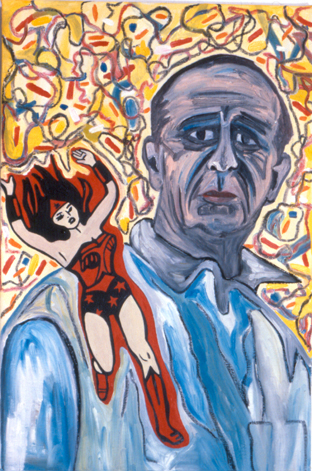
Susan Bee, Marsden Hartley Meets Wonderwoman, oil on linen,
1983, 30 x 20".
Around 1978, I joined a women artist’s support group called Tycho that showed together and we had discussions about our work. Meanwhile, from the mid-1970s, I had became very involved with the poets around St. Mark’s Church’s Poetry Project and L=A=N=G=U=A=G=E magazine. I worked on the design of L=A=N=G=U=A=G=E, pasting it up by hand (precomputer) in my apartment from 1978 to 1981. And after that I worked with the Segue Foundation, designing many of the early Roof books. I also went to lots of performances of Robert Wilson, Philip Glass, Richard Foreman and Kate Manheim, Jackson Mac Low, Charlemagne Palestine, Dick Higgins, Alison Knowles, and the Fluxus group, Douglas Dunn, Yvonne Rainer, Richard Schechner, the Living Theater, and early performances at the Kitchen. I went to the Franklin Furnace and Printed Matter to look at artist’s books and I showed my books there.
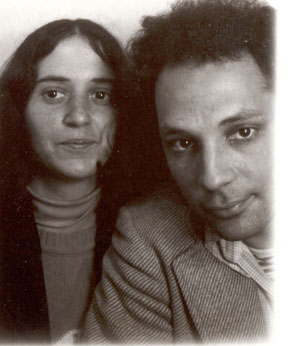
Susan Bee and Charles Bernstein, c. 1975
The women poets and writers that I met at that time were a crucial company for me and the poetry community that they formed marked a stark contrast to the art world, where commerce and transient fashion too often trumped both aesthetic values and sisterhood. So I think of friends such as Hannah Weiner, Lyn Hejinian, Johanna Drucker, Kathy Acker, Rae Armantrout, Susan Howe, Lynne Dreyer, Diane Ward, Bernadette Mayer, Anne Waldman, Ann Lauterbach, Mei-mei Berssenbrugge, Abigail Child, Erica Hunt, Lydia Davis, Leslie Scalapino, Madeline Gins, Adrienne Rich. They showed me a way to proceed to do your artwork and how to find your voice in a male-dominated world and they offered important support during those years. Male poets and artists such as James Sherry, Ron Silliman, Bruce Andrews, Nick Piombino, David Reed, David von Schlegall, Arakawa, Henry Hills, John Yau, Robert Creeley, Jerry Rothenberg, Bob Perelman, Richard Tuttle, and Ted Greenwald, were also very much part of my life then, especially Charles, who I met in high school and married, after years living together, in 1977.
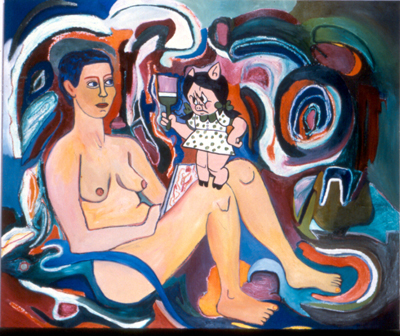
Susan Bee, Portrait of the Artist as a Young Pig,
oil on linen, 1983, 50 x 60".
From 1980 to 1985, Mira Schor and I participated in a discussion group of younger artists and critics (men and women) that meet initially at A.I.R. In 1982, I spoke on a panel at A.I.R. titled "Critics: A New Generation." In 1984, I was in Women Artists of the 80's: New Talent, a group show at A.I.R. curated by Corinne Robins. Mira and I decided to publish M/E/A/N/I/N/G in 1986 and we kept the print version going for 10 years till 1996. We then published the M/E/A/N/I/N/G Anthology in 2000 and started M/E/A/N/I/N/G Online in 2002.
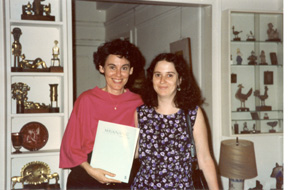
Susan Bee and Mira Schor holding M/E/A/N/I/N/G #5,
1990.
In 1996, after many years of struggling to get my paintings shown in commercial galleries (and only occasionally succeeding), I joined A.I.R. Gallery and became part of another community of women artists that is still active. Since joining the gallery, I have had four solo shows, participated in numerous group shows, and been part of monthly meetings.
Looking back on the 1970s, I realize now that the whole fabric of the times was in flux and that the energy of the feminist art movement was just one important part of the larger blossoming of avant-gardes and undergrounds and political movements. Community remains a work in progress for artists: still urgent, still flawed. The 70s laid a groundwork on which I continue to build.
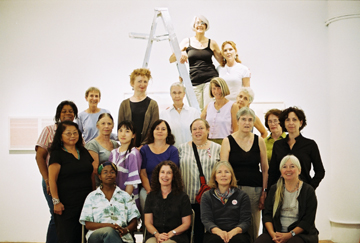
Susan Bee (center in purple) with members of A.I.R. Gallery,
NYC, 2006.
Susan Bee is a painter, editor, and book artist living in NYC. She shows at A.I.R. Gallery and Granary Books publishes her artist's books. She teaches in the School of Visual Arts MFA in Art Criticism program. Bee will show paintings in A.I.R.'s 35th Anniversary group show in NYC in Feb. 2007, the show travels to the Putney School in Vermont. She speaks at the CAA on her artist's books on Feb. 17. Bee will do a presentation on collaboration with Johanna Drucker at the Bowery Poetry Club on May 5.
After attending “The Feminist Future” symposium at the Museum of Modern Art ( January 26-27, 2007) I don’t think I will ever look at or create art as I did before. This is one of feminism’s greatest triumphs: to change the way people look at and experience the world, to challenge assumptions and provoke interrogation. However, why did it take the attending of a symposium for me to experience this change?
All of the seeds for my feminist future were well planted. I grew up around strong feminist artists, my mother Susan Bee and her many colorful friends. I was raised to be aware of the struggles of womanhood. I had subconsciously internalized the fly-by story of 1970s feminist art as many of its practitioners were friends of the family, and its books and manifestos lay invitingly around the house. At a young age I began to subscribe to Ms. magazine, and my early heroes included Frida Kahlo, Gloria Steinem, and Sylvia Plath. It was when I discovered feminist punk music at age thirteen, though, that I truly came of age as a young activist. Kathleen Hanna, who helped form the Riot Grrrl movement in the early 1990s, was the first feminist idol I truly identified with. Although I was slightly late (I discovered Riot Grrrl ten years after its heyday), the closer connection in time period and age made a huge difference. It was something my parents could not understand, and that made it appealing. Hanna’s band Bikini Kill, with their incendiary call to action “Revolution grrrl style now!,” created an aesthetic and a movement that formed my identity as a young teenager. Riot grrrl was a style of dress, an attitude, a way of life… I soon found that there was a NY chapter of what had become a nationwide feminist D.I.Y. (do it yourself) organization, and started attending weekly meetings on the Lower East Side, where I found like-minded punk girls to write zines and start bands with. We rejected ideals of body image, embraced sexuality and wild style, and adapted an aggressive and impassionate attitude. We started pro-choice protests, had “punk proms,” brought food to women’s shelters, and crashed male-dominated mosh pits. The best thing about my involvement with this group was the sense of being a part of something, not apart from everything (a semantic feminist truism Linda Nochlin pointed out this weekend).
Over time though I grew out of my pink hair and fishnet tights, and became tired of the constant battling between the heterosexuals and the lesbians, the man-haters and those of us who wanted to include boys. I became disillusioned with the “sisterhood” and sadly left the scene. I wouldn’t return to my early feminist days for nearly six years, although the effects of my early involvement were always felt. I began to find more solace in denial, in trying to transgress the boundaries of gender and be a person rather than just a woman. In many chats throughout the years with female friends, even former riot grrls, the word feminism seemed to have become shrouded in a veil of fear. I continued to be privately inspired by woman artists and musicians, but I rarely advertised my predilections. I found that feminism was no longer “cool,” and it made me feel unappealing to identify with it.
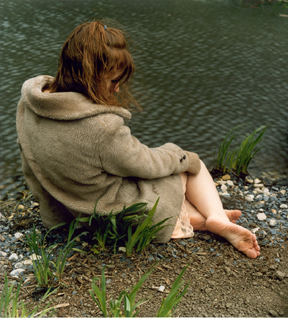
Emma Bee Bernstein, untitled, color photograph, 2004.
Throughout college I have gradually outgrown this fear. As an Art History and Studio Art major I never elected to take a course related to feminism, but my artwork and interests became increasingly concerned with issues related to the representation of women. I began to work as a photographer for my school’s pro-sex erotica magazine, and as a result was constantly asked to defend my positions towards pornography and feminism. In my art classes I was also pressed to explain my predilection for taking photographs of scantily-clad femme fatales. My art history BA thesis started as an examination of the intersection of contemporary fashion and art photography, but I kept being most fascinated with how this related to the changing representation by and of women. Eventually I realized that my avoidance of feminism and its history was hurting rather than helping my work and studies, and I began to try and make up for lost time by devouring any text or artwork I could find related to it. It was fortunately at this exact moment that I also found out about the feminism symposium at MoMA, and its scholarship fund. I eagerly wrote up an application for the conference, which appealed to my voracious appetite for feminism at this pivotal moment. When accepted, my enthusiasm only grew, and in the preceding weeks my entire attitude towards feminism changed in anticipation of the conference.
There is no way for me to address here all the issues and ideas that the conference provoked and inspired. There were many highlights, and many sour notes as well. The symposium was successfully bookended by Lucy Lippard and Linda Nochlin who gave the most rousing and positive speeches, making gestures to the power of the collective, the personal as political, and the individual situated in the ism. However, it was in some of the more troubling and complex presentations that the problems of the future were truly allowed to manifest. Marina Abramovic’s defiant (and unquestioned) statement that she was just an artist, not a feminist artist, coupled with her ambiguous video satire of Slavic fertility myths seemed to illustrate the unfortunate consequences of using ribald humor to avoid confrontation. Coco Fusco, however, effectively used comedy to raise the most vital issues facing contemporary feminism: sexuality as subversive power, the personal as profitable, and the artifice of the art market. Unfortunately she was the first and last speaker to take a successful stab in this direction. Even Griselda Pollock, perhaps the most powerful speaker, quickly ran through these issues, using dismissive terminology (the cosmetic commodity culture of spectacle and capitalism) to bypass what are complex and vital issues facing feminism. Why are so many women artists interested in fashion and traditional constructs of feminine beauty? Why is the material spectacle of the art market such an appealing force for young women? Why are women not more defiant towards these forces? Ingrid Sischy alluded to her interest in these subjects, but didn’t address their controversial status.
If the conference was disappointing at all, it was in what seemed to be a general avoidance tactic, instigated through the usual utopian flair for glossing over the truly problematic issues, ranging from tokenism to glamour to the art market. There was a general focus on rehearsing the glorious past, which was essential and enlightening for me, but also seemed to detract at times for the purpose of the conference at hand. This approach seemed most relevant when related to the “writing the history of feminism” and the “institutionalization of feminism” panels, which made understanding of the past an integral element of the future. However, it was less than necessary to rewatch every one of Martha Rosler’s video pieces. The audience participated and perpetuated this waste of time by reciting memories and odd public relations requests, instead of asking relevant questions or taking advantage of the wonderful thinkers on hand.
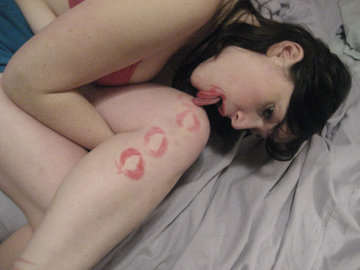
Emma Bee Bernstein, untitled, color photograph, 2006.
Despite these setbacks, many of the espoused theories were challenging and inspiring. Anne Wagner’s call to the feminist imagination to continue to reinvent the monstrous; the idea of negation, ambiguity, and opposition as essential feminist tools (Wagner and Nochlin); Uta Meta-Bauer’s thesis that theatrical methods act as challenges to previous systems of reference; David Joselit’s definition of a picture as a transgendered agent, which engenders many attitudes, his inkling that the performativity of any artwork and its activism are linked through a simultaneous process of exteriorization of an interior and interiorization of an exterior; Griselda Pollock’s plea for sustained creativity rather than novelty for novelty’s sake, non-Oedipal models that cause respect rather than rebellion in genealogies, for a feminist future that we live beside not below, “the right to say WHO I am, not WHAT I am,” to have feminism conflated with the feminine, for the feminine and masculine to be understood as metaphors, symbols, tools, that create positive dimensional action in all sexes, that the symbolic gesture of maternity be an art world ethos where artists can rear the next generation without having to claim anything in return; Richard Meyer’s championing of the effeminate man; the Guerrilla Girl’s demand for power in anonymous numbers; Helen Molesworth’s call for a museological genealogy of brothers and sisters rather than fathers and mothers; Nochlin’s powerful quotation from Milton that the feminist future render us “Sufficient to stand, but free to fall." These ideas and more are what made the conference the stimulating and moving event it was. Nonetheless, the most inspiring and powerful effect of the whole conference was still the feeling it gave me of being a part of something, rather than apart from everything. Perhaps this is the true triumph of the conference and the real hope for the future of feminism: the sustained creation of communities of support, the continued bonds of sisterhood, and the never ending symbiosis between the personal and the political.
Emma Bee Bernstein was born in 1985 in NYC. She
is a senior majoring in Art History and Studio Art at the University
of Chicago. She received a Feminist
Future Scholarship to attend the Feminist Future Symposium at MoMA. She
stars in Henry Hills' film, Emma's Dilemma (2005), in which
she interviews Richard Foreman, Ken Jacobs, Tony Oursler, Carolee
Schneemann, and many other artists and poets.
Johanna Burton
I came late to feminism, by which I mean that I was born in the early 1970s. In that way, of course, I “missed” the being-there part of a movement (a philosophy? a gathering? an argument? a resistance? a discourse? a practice? a way of life? an aesthetic? a dream? a desire? a revolution?) to which I felt nonetheless totally cathected and totally indebted. Yet, as my parenthetical list above probably makes clear, as much as I identified with feminism—from the moment I heard the word and even, I think, before—I didn’t exactly know what it was. It was handed down to me by way of evidence that I found in my small-town library: books and articles that I mostly lucked onto since I wasn’t quite sure what I was looking for and that I read with an appetite that surprised and thrilled me.
This is all to say that in the late 1980s and early 1990s, I experienced 1970s feminism and looked at its art, albeit in a deferred and almost entirely solitary way. I was lucky to have an art history professor who taught courses on the subjects (in Reno, Nevada, definitely not to be taken for granted), and a friend or two similarly inclined. But, overall, my first encounters with feminism—its histories and its conversations—were taken up from the double divide of time and place. This, I realize now, made my discovery of its figures, its terms, and its relevance all the more potent. For however “late” I had arrived to feminism, it seemed urgent and relevant and powerful—a tincture still waiting to be drunk. It is no exaggeration to say: those who argue that the lessons of feminism have been fully absorbed and outdated need only spend a week or two in the hinterlands of America. It’s amazing how “fresh” feminism feels there.
That said, the artists that I learned about first—whose work, by that time, spanned from the late 1960s upward nearly thirty years—were not necessarily or even pragmatically related, aside from the fact that they were all women and could be claimed, in one way or another, for feminism. This meant that Betye Saar, Francesca Woodman, Barbara Kruger, and Yvonne Rainer (and such historical “precedents” as Claude Cahun and Rosa Bonheur) were ostensibly “common” to one another, if only in the following ways: I was “interested” in all of their practices, and I generally would only hear about these practices if enrolled in a class or reading a book about “women” artists. Such an initial generic leveling is, of course, customary to any topic with which one is just getting acquainted. Yet, I bring it up here because it seems that such a wide and unruly net does not get tightened and honed as a student works her way from 200-level classes to graduate school (if classes in feminist art are even on offer there) and beyond.
I am not making an argument that the most pressing issue for feminism or feminist art history today is its lack of internal distinctions or specialization. But I am concerned that “feminism” is often offered tout court—take it or leave it—before the person to whom it is offered can even be sure what it is they’re deciding on. This accounts, I think, for so many of the continuing conversations (at the beginning of every course on feminism, during the Q & A of every conference devoted to it) that return to the question “What is feminism?” It also accounts for a certain fatigue and suspiciousness in younger students (some of mine at least) who want to discuss politics, representation, ideology, and repression but feel the word “feminism” might confuse these issues rather than clarify them. Indeed, while I was (and still am) exhilarated by including myself almost blindly in the “we” of feminism, I wonder if such a provisional and exploratory model of loose collectivity continues to capture the imaginary of younger women.
This captured imagination is important. I signed onto feminism even
before I knew why, and then I started sifting. The work that I found
myself gravitating toward, I realize now, was usually generated by
a kind of alchemical dosage of euphoria and anger—a recognition
of an unbearable structural situation and one’s agency
to work against it. Here are some of the artists whose work embodied
this kind of energy for me and allowed me to articulate some kind of
position in relation to the world myself: Julie Ault, Dara Birnbaum,
Felix Gonzalez-Torres, Joan Jonas, Mary Kelly, Sherrie Levine, Adrian
Piper, Mira Schor, Nancy Spero, and Rosemarie Trockel (to just get
started.) My list may look just as unorganized as those I complained
about above, but it bears the imprint of my logic and is everywhere
evident in my own work. I can make a similar list of writers, historians,
and scholars. My practice today of art history, criticism, and pedagogy
returns again and again to thinking through the productivity (and production)
of a feminism to which I was late but also just in time. How to maintain
this timeliness for others (and myself) remains foremost in my work.
Johanna Burton , a NY-based art historian and critic, is the editor of the critical essay collection, Cindy Sherman, (MIT Press, October Files, 2006). She is the author of an article on the women-only art magazine Eau de Cologne, in Witness to Her Art (eds. Rhea Anastas and Michael Brenson, Center for Curatorial Studies, 2006). A faculty member of Bard College’s Center for Curatorial Studies and Columbia University’s School of the Arts, she was a critical issues fellow in the Whitney Independent Study Program and is writing her dissertation at Princeton University on appropriation in American art of the 1980s.
Ingrid Calame
When I came of age in the late 80s, the 70s–when Linda Benglis posing in the Artforum ad with a dildo was radical–seemed eons ago. Unfortunately the politics of today make artwork from the 70s quite fresh–as we fight for similar rights, and freedoms AGAIN. The work of Nancy Spero on war and mythology and Adrian Piper on race, were important in my development as a person but they seemed wedged into history books.
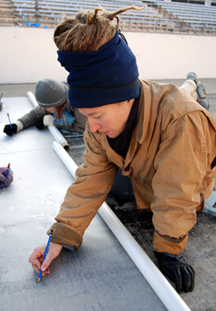
Ingrid Calame tracing the Indianapolis Motor
Speedway, Indianapolis, IN , 2006.
Fortunately, knowledge doesn’t stay in timelines and history books, but gets braided back into life. My involvement with the people who have made and lived history has blurred decades and disintegrated categories. Their ideas have taken a while to percolate into the core of my being. Most of my mentors and models have been women. Teachers such as Mira Schor, with her contribution about feminism and painting have become lifelong friends. When I graduated from SUNY Purchase with my BFA in 1987, I went to work as a studio assistant for artists including Nancy Davidson, Harriet Shorr (who had been my teachers), Janet Fish, and Martha Diamond. They became my models for what it is to be an artist how to run a business, as well as how to keep afloat as an artist emotionally and spiritually. I also learned a lot of painting chops by being a fly on the wall. Carole Byard introduced me to a world of African-American artists, such as Betye and Alison Saar, of whom I had not been aware. She helped me understand my own interracial extended family, as well as the racism and classism built into how I understood it growing up.
My paintings and drawings have deep resonances with the feminist art movement, in their grounding in the body as the pivotal point from which to make artwork. Having always been a painter, it took stepping outside of this practice to better understand its fundamentals. When I was studying film at CalArts in the mid-90s, I realized that a cornerstone of painting was using one’s body, as opposed to a camera, as the tool of translation of information. This affected the scale of the images that I made as well as the information from which I worked. By tracing stains on the street I was using the limits of what I could see and do with my body to gather information. This relates directly to the performances of Carolee Schneemann and paintings of Joan Semmel from the 70s, as well as the earthworks of Robert Smithson and the structuralist films of James Benning. The work in early ninties of Kiki Smith and Sue Williams helped me recognize that the body was a terrain that mattered to me in my gut and my intellect.
My interest in the body as a starting point comes from its absolute familiarity and uncontrollability. The irreducible fact of human mortality makes it the ideal place from which to look at the issue of abstraction. I am interested in how we feel confident that we know anything in this increasingly fractured but claustrophobically collapsing world. My own questions about identity–racial and sexual –fueled my questions about representation, but rather than take on identity politics, I chose to take up the question of the abstraction of representation. Painting, with its history of abstraction, was the perfect location for an investigation into worldly abstraction because there is an intrinsic historical conversation about representation versus abstraction. The work of Polly Apfelbaum, Mary Heilmann, and Jessica Stockholder, primed me for this question when I lived in New York in the early 90s. Since I moved to LA, my peers Monique Prieto, Laura Owens (both CalArts classmates), Linda Bessemer, Sally Elesby, and Berlin-based Katharina Grosse all work on variations of this question which I find moving.
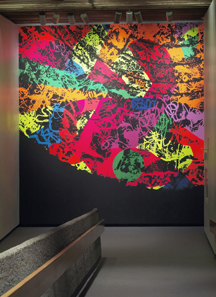
Ingrid Calame, Secular Response 3A (Tracings up to the L.A. River placed in the Clark
Telescope Dome, Lowell Observatory, Flagstaff, AZ), installed at Art Gallery of Ontario,
Toronto, Canada, latex and One Shot paint on wall, 16' 6" x 17' 5",
2006.
Finally, I have found much inspiration in the unusual career of Alexis Smith, bifurcated between ambitious public art works and intimate art world collages. Recent shows of her collages in New York and LA made me reflect on the time that has elapsed since 1991 when I first saw her work in her Whitney Museum mid-career survey. At that time I felt that the attitude in the collages was ironic and I was on the outside of the joke. Today I feel that they pose urgently pointing questions towards current politics in which I am all too enmeshed.
Ingrid Calame is an artist born in NY, who lives and works in LA. She is represented by James Cohan Gallery in New York and Galerie Schmidt Maczollek in Cologne, Germany. Her current project is tracing tire tracks and skidmarks from the Indianapolis Speedway. The resulting works will be on view at James Cohan Gallery, NY (Sept. 2007) and the Indianapolis Museum of Art (Nov. 2007).
Maura Coughlin
My understanding of women artists in the 1970s begins with my mother, a painter who was born and educated in the Caribbean, and who met my father in the 1950s at the Rhode Island School of Design over a borrowed jar of turpentine in a drawing studio. Her experiences at art school in the 1950s shaped her as a woman artist in a few remarkable ways. In her freshman foundation course, a professor at RISD told her class of mostly women that only 1 in 50 would stay in the arts after graduation, that women never became ‘real’ artists. My mother says she never knew whether this was posed as an insult or a challenge, but to prove him wrong she never stopped painting, and, in 1969, as a two year old, I ran madly throughout the crowd at her MFA thesis exhibition.
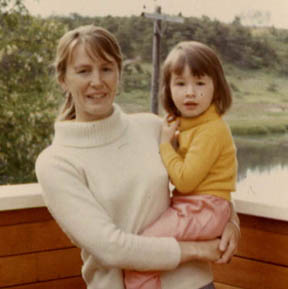
Joan Hopkins Coughlin and Maura Coughlin in Wellfleet, Mass. c.1970.
Growing up in the 1970s in a family of artists, I was often brought along to art department cocktail parties in Amherst, Mass. My vague memories of these evenings include a lot of leather fringe, woven wall hangings, cigarette smoke and caftans. Some of my father’s colleagues had much younger girlfriends who I later came to realize were their graduate students. Art department wives, many artists in their own right, and equally as qualified as their husbands, either faded into the background after divorce or clung on to miserable adjunct jobs teaching continuing ed classes at night. Nepotism rules prevented many women from being hired in the same department as their husbands: the men on the other hand made tenure incredibly fast as art departments expanded to accommodate the baby boom. I’ve come to realize that in the 1970s, feminism came too late to help these women, but their academic and personal situations were powerful catalysts.
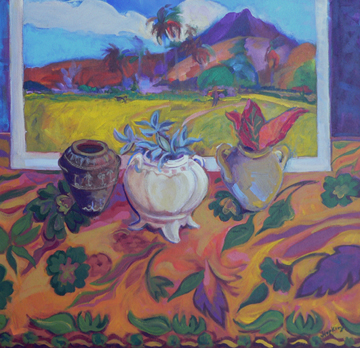
Joan Hopkins Coughlin, Jamaican Still Life for a Winter’s Day, c. 2000.
Maura Coughlin teaches art history as a visiting assistant professor at Brown University. Joan Hopkins Coughlin is a painter and landscape painting instructor who, since the late 1980s, has been working with themes relating to her childhood in Jamaica.
I was born sixty-five years ago into a blue-collar Irish Catholic family in Philadelphia. The walls of our Euclid Street row house were hung with small, pressed-board-made-to-look-like-brushstrokes reproductions of Jesus, Mary, and the saints. In church I saw the same cast of characters, especially the saints, in larger, more physically present paintings of transcendent bodies, oozing blood, guilt and gilt, all bathed in a celestial light. Those powerful art images both seduced and repelled me; I wondered at the mortality of their immortal flesh .
Later, a scholarship to Moore College of Art in Philadelphia made it possible for me to be the first student in my family to advance beyond high school. At Moore, I was introduced to the more laic, sophisticated world of fine art. Art history and studio classes fed my appetite for words and images. It was the early 60s, and my now lapsed Catholic dogma-radar quickly recognized the prevailing Abstract Expressionist creed. While not my cup of tea, the predominant "paint for paint's sake" ideology and practice helped me begin to understand that physical process was more powerful than depiction of the physical. The heady days of art school immersion flew by, and when it all ended I had to make a living.
After graduation, I worked in New York as a graphic designer for a prestigious design firm. In 1969 I left New York and advertising, learned to drive a car, and moved out west to the halls of academe. For the next thirty years I taught art and design at the University of Arizona and worked in my studio. The tenets and practices of the university and the art world shared a lot with Madison Avenue and the church. All of these institutions know how to employ images and words to exert power and control over their audience, an audience made up of themselves, people who crave love. I did too, but it was tough sledding gaining acceptance in the art world because, to paraphrase Groucho Marx, "I wouldn't want to belong to any club that would have me as a member."
Western art's history, where women either occupied a lower rung of the hierarchy or were absent from the canon, continued to influence the contemporary art world. So I operated at the margins, not a bad place to be, but it leaves you, well -- marginalized. I continued to make art and to read, but always felt that I didn't speak the current argot, didn't know the secret handshake. No small problem.
I had studied at the feet of the Masters. What I needed were the Mistresses. In 1976, I was invited as the representative for Arizona to be part of a 1977 national exhibition, Contemporary Issues: works on paper by women, sponsored by The Woman's Building in Los Angeles and the national Women's Caucus for Art. In the invitation text, Judy Brodsky described the exhibit, curated by thirty-seven women, as the "work of nearly 200 women from over 30 states." The show included Lynda Benglis, Alice Neel, May Stevens, Nancy Spero, Hannah Wilke, Ellen Lanyon, Anne Noggle, and Nancy Grossman, to name only a few of the artists who would grow to be important to me. I saw art that was personal and diaristic; representational and abstract; made with lace, buttons, fabric, thread, crayons, plastic, waxed paper, dirt, steel wool, and magazine texts -- the quotidian artifacts of our lives. I know that these "non-art" materials had been used before, but it was the way they were used by these women : I particularly remember Miriam Schapiro's Mary Cassatt and Me, which she described as a collaboration with Mary Cassatt. What I valued in her work in that 1977 exhibition was the direct art historical line that she drew to one of the few female artists in the art canon at that time. It all seems very obvious today, but those second-wave feminist artists, many who like Mimi have become friends, gave me greater permission to trust my own voice. It's true that the feminist art movement had its own dogma and attendant codes -- from my experience that's hard to avoid in any political movement -- but feminism spoke a language that I understood, and that language helped me to understand my place in relationship to all those other institutions with which I had a lifelong ambivalence.
Obviously, the increasing trust in my own voice didn't make the process of creating art any easier, but it made my involvement more complex and intense . . . and less solitary. For me, making art is burrowing deep into my own body. When I'm really immersed, I may not bathe for days, enjoying my own animal smells. But I clean up for my friends and they keep me, if not immaculate, at least clear. What would I do if I weren't able to talk to my dear friend, Joanna Frueh, one of many women artists who are so valuable to me ? It is a network that has taught me to get it -- knowledge, experience, love -- and pass it on. I know from years of teaching at the University of Arizona and my many visiting artist gigs that what I do and say as an older woman artist is profoundly vital to young female and male artists. My art has evolved over the years. I continue to be interested in the body in relation to time; episodic movement -- flipbooks, cells, comics; language's information and misinformation; and finally, durability. I think the effects of a life lived on the physical body are endlessly poignant, beautiful, and humorous . My drawing process reflects this: I lay down a dark ground and abrade the blackened surface to light, wearing it away to the scarred smoothness and luminosity of a river stone from an Arizona arroyo. Recent works are large paintings and drawings of my friends and I -- our topography of flesh bathed in a celestial light; my hagiographies of everyday bodies that shine like saints.
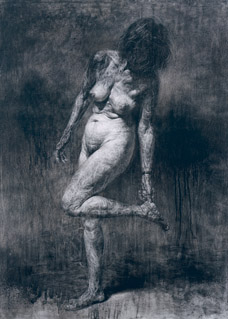
Bailey Doogan, Self Exam In Nation, charcoal on primed paper,
one panel: 72" x 52", overall size: 72" x 218", 2003 - 2005
The 2005 drawing, Self Exam In Nation, is derived from a series of nude photographs with me as the model. Like many other people, I have a great deal of difficulty really looking at the naked truth. That lack of personal corporeal consciousness often reverberates to the national corps -- I started this drawing in the late-winter/early-spring of 2003 when our country invaded Iraq. The personal continues to be political.
Bailey Doogan 's recent retrospective was accompanied by a catalogue, Bailey Doogan, Selected works, 1971-2005 with essays by Mary Garrard, Joanna Frueh, Lucy Lippard, May Stevens, and an interview with Julie Sasse. A Professor Emerita from the University of Arizona , she continues to draw and paint in her Tucson studio.
I was in California in the 1970s, having moved to the Bay Area to enroll in what was (then) the California College of Arts and Crafts to study printing, printmaking, and drawing. Judy Chicago's name was in the air. She was the first woman artist linked to the term "feminist" in my experience.
Growing up, as I did, with a strong orientation towards literary traditions, I had many models of women artist-authors before me. Colette, Jane Austen, George Eliot, the Brontes, Virginia Woolf, Anais Nin — all had in some part contributed to that synthetic image of the successful woman writer. Issues of self-determination with regard to sexuality or subjectivity were beyond my conceptual reach. Mine was a literal, almost mechanistic emulation. I wanted to do what they did to be who they were. Sheer labor and persevering effort seemed the key, rather than a politics or ideology of informed debate or struggle.
In the public arena, we had watched Gloria Steinem, Betty Friedan, Bella Abzug — and, for that matter, Golda Meir, Barbara Jordan, Rosa Parks, and other strong brave women — embody or declare an agenda in which women's rights had a distinct outline. I was not among them.
Far behind and hideously reclusive, shy in the worst ways that culture and adolescence can produce as a combination of inadequacy and crippling self-consciousness, I was happy to be safely removed from the fray. I imagined that feminism was a term associated with a refusal of cosmetics modifications. Hairy, heavy, ungainly, abrasive — such were the adjectives that upped anxiety when the word feminist was spoken aloud. Breathed in a room, class, or lecture, feminist conjured a school-marm didacticism in which fun was prohibited and playfulness seen as trivial given our need to stay focused on the constant struggle against the patriarchal oppression within which we were all trapped. Such went the litanies.
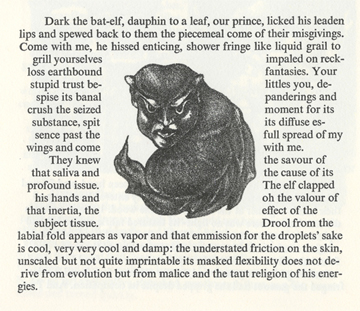
Johanna Drucker, page from Dark, letterpress,
1972.
Oddly, it was my male roommates in the first years of my California life, mocking the poor repressed Pat Nixon, who brought some of the initial glimmers of alternative life to light. Women roommates as well, mentors in the ways that girls can be to each other, showed, reinforced, demonstrated what it meant to take control of one's body, self, social and sexual life. Even so, I was slow, holding back, aloof, apart from a sense of solidarity with women or a movement.
Feminism? My artwork, such as it was in those juvenilia days, had a deliberate neutrality. I wanted to learn to draw. So I drew sticks and natural fragments, objects, leaves, desert landscapes, all kinds of organic forms. Or I drew characters from my imagination, writing in code.
At an age when I was terrified of almost everything physical or sexual, unable to look at myself naked, let alone strip bare in any other circumstance, works of art that dealt explicitly with female sexuality or experience made me squeamish. I wasn't a huge fan of Georgia O'Keeffe. I found her abstractions too austere in their abstraction and too queasy in their finish, a bad combination of too little and too much, severe and slightly sickening. Judy Chicago? A pop version of O'Keeffe, writing about Her Self, and appearing with her glasses, work boots, and sturdy anti-glamorous presentation, she was the epitome of what I did not want to be or become.
I had a friend at the time who was a painter, a touch older than I, and with that edge of knowledge that allows for conviction in the gap of experience that put her ahead of me on the road to insight. She was a complete fan of Chicago, though critical and aware of the aesthetic issues, limits, ideas that might be raised. She was married at the time, but in our conversations I always felt an anxious undertow, pulling pulling me towards something I didn't understand except to resist it. She was gay, as she later revealed, coming out a few years later. My resistance had simply been to desires she was no doubt still trying to formulate herself. But the link between feminist and lesbian was also off-putting, raising other spectres for which I had no framework, just unfounded and mythic imaginings. The social anxieties around how to become a woman were so intense that I think I could no receive any information about feminism without their being charged by vague fears. Isolated enough, I was worried that I would become even more remote from mainstream sociality. Judy Chicago? Pictures of vaginas? No way.
With historical hindsight, and after teaching the work of feminist artists the women's movement, my late adolescent response to Chicago seems cast in another light. Her invitation to liberation was wrongly posed for who I was at the time—intellectually intense and caught up in the life of the mind. I wanted a boyfriend, not sisterly solidarity. I wanted romance, not community. Doris Lessing's Martha Quest novels, not Patti Smith's music or Kathy Acker's writing, were the means through which notions of feminine and, eventually, feminist consciousness came to make sense.
The social realm had the strongest effect. Women friends became the instrument of greatest change, striking home at crucial moments when confusion over power relations in the world of poets, or difficulties with teachers and institutions, or various troubles in intimate connections all needed to be aired and addressed.
Often it was a quick turn of phrase that changed my outlook entirely, an "of course that's how they respond" remark to my surprise at a criticism or a rebuff. "Of course." That phrase carried the full conviction of convention, the message of ideology as a system that colonizes even interior life. Of course I couldn't like Judy Chicago, of course I was terrified by the threat of isolation, of course I had to distance myself from feminist rhetoric — I had no foundation within my experience on which to let such aesthetics and experiences take root. "Woman artist" was a diminished and derogatory term in my vocabulary, struggling as I was for any sense of self. Later later one sees the game, the machinations that tinge the tools of liberation with pejorative associations.
I was slow, slow indeed, and the women and critical discourses of M/E/A/N/I/N/G helped shift the fulcrum point of power in my mind, showing the possibilities I associate now with a conscious and deliberate turn towards self-determination. But I was slow, late, and had to be awoken to the urgencies of that awareness through difficult circumstances. Now? I appreciate the benefits our generation gained from the struggles and successes of an older one. Hidden costs are still being revealed. In the artistic realms, gender no longer carries the same stigma. But gender and subject positions are still linked. I still don't care much for Chicago's work, in spite of the best efforts of some of my esteemed colleagues. But I respect her work and her self-construction, along with that of many other women whose efforts broke the ground from which much that is vital has sprung: Carolee Schneemann, Miriam Schapiro, Audrey Flack, Marisol, Joan Brown, Elaine de Kooning, Grace Hartigan, Nancy Spero, Mary Miss, Nancy Holt, Yoko Ono. I didn't see them in that time, I couldn't look and didn't know how to understand the importance or substance of their work. We didn't have the vocabulary we have now. If I were eighteen at this moment, I'm not sure that anything would be much different for me than it was more than three decades ago. Personal disposition still colors experience. Certain kinds of development has to be lived through. I think young women artists start from a very different place, but the game has also changed. New issues limit their horizons. But I am not at all sure that I have done yet with the limits on my own. Much still lies ahead.
Johanna Drucker is the Robertson Professor of Media Studies at the University of Virginia. She has written about the history of books, writing, digital aesthetics, contemporary art, graphic design, and experimental typography. Her most recent publication is Sweet Dreams: Contemporary Art and Complicity, ( University of Chicago Press , 2005). She is also internationally known as a writer and book artist, new titles include From Now (Cuneiform Press, 2005), Cuba (with Brad Freeman, Jabbooks 2005), and Testament of Women, (Granary and Druckwerk, 2006).
The following is a condensed version of something I wrote about the 1970s several years ago in The Aesthetics of Power: Essays in the Critical History of Art ( Cambridge University Press, 1993).
For me, the 1970s began in 1968 on the campus of Columbia University. In the spring of that year, as I was finishing my Ph.D. in art history, students active in the Civil Rights and anti-Vietnam War movements triggered a strike that brought the campus to a standstill. The students introduced a new culture of protest into every corner of the campus and in a matter of days taught some hard lessons about the limits of liberalism in educational institutions. It was something of a shock to watch the reaction of some of the professors in my department. Although renowned as humanist scholars, they seemed utterly unable to recognize the issues raised by the students, never mind taking a stand on them. Their reaction worried me and deepened some fears I already had about the discipline of art history. Their willingness to disconnect the politics of their professional lives in the university from the politics of the world outside – didn’t this replicate art history’s avoidance of the social and the political meanings of art? Eventually, the campus calmed down and resumed its usual business. But the questions kicked up by the crisis did not go away. On the contrary, they became more compelling and complicated as time went by, especially with the appearance of a new wave of feminism and what was then called Gay Liberation. That is how the 70s began for me.
And it seemed to me that a lot of other people were in a similar place. One could feel connected, no matter how vaguely, with other people, not only other artists and intellectuals concerned with civil rights and social justice, but also psychologists, journalists and unionists who felt the possibility of social change and psychological expansion and worked to bring it about. It was that feeling of possibility that I most associate with the 70s, and a sense of shared conviction that what we wrote or taught or made or did could be linked to larger struggles and situations. So, along with like-minded artists and academics, I participated in study groups, consciousness-raising groups, editorial collectives, and radical caucuses, seeking insights and tools with which to study the social, political, and psychological meanings of art from new, more open vantage points. I wanted to know about the intersection of art and power in the past and the present and also about the ways art contested power.
As someone trying to assimilate
the Marxist tradition, it did not seem possible (after 1969) that one
could be a Marxist and not also a feminist. Reading Marx and the Marxist
tradition along with a developing feminist discourse helped frame the
issues I wanted to explore: motherhood as an historical concept, the
changing nature of patriarchy, the meanings of female nudity in art,
and so on. Marxism and feminism together suggested a world that included
clashing interests, complex social relations between the sexes and
races as well as classes, changing ideological needs, and changing
uses for art—in
short, a world in which art is not a neutral or passive reflection
of historical experience but a part of the action. Above all, Marxism
and feminism insisted on the connectedness between things, between
the history of subjective experience and the objective, social world.
Subsequent history was rough on the optimism of that era. Even so,
there is still some 70s left in me. It is the decade that most shaped
my outlook and values, and I count myself fortunate to have lived through
it.
Carol Duncan is Professor Emerita of Art History at Ramapo College of New Jersey. Her essays, including “Virility and Domination in Early Twentieth-Century Vanguard Painting” and “The MoMA’s Hot Mamas” have been collected in The Aesthetics of Power (Cambridge University Press, 1993) and Civilizing Rituals: Inside Public Art Museums (Routledge, 1995).
Mary Beth Edelson
The stand-out woman for me in the 1970s was Louise Bourgeois. Her influences included not only the woman-centered gut wrenching imagery she produced with the abandon and courage it took in those days to weather predictable responses, but also herself as a human being. Louise would come to A.I.R. Gallery and tug on your sleeve asking how you got into this or that exhibition. Louise never gave up, and the best part is after all those years, it finally paid off, and she lived to enjoy it.
Reassessment
I am not hearing many reassessments that go deeply into new territory on the profound influence of feminism that has permeated our world on every level--locally and globally. We could use a best seller with a clear message and slogan to go with it that will capture people’s imagination and finally place feminism in perspective for the whole population. Followed by many more. I am ever aware and grateful for what the 70s feminist community did for me. As groups, A.I.R. Gallery and Heresies in
particular, as individual women, Suzanne Lacy for her wisdom, Nancy Spero
for her inspiration, Mimi Shapiro for her support, and Lucy Lippard for being there. The list goes on. Feminism’s influences have not been static, but have transfigured my art making many times over.
My current projects that spring from the processes of the feminist circle, (non-hierachical, collaborative, giving credit where it is due, structured, group and self-crits, etc), that we actively practiced and produced in the 70s, include workshops produced in collaboration with college students and local residence to create appropriate projects for their community. These workshops build on, while adding to, the feminist working processes we devised in the 70s. Currently a three-year project, titled Utopiana, is in the process of being produced with the small historical town of New Harmony, Indiana, famous for its early (1816) roots in an utopian experiment. The workshop consists of both townspeople and a group of students from near by University of Southern Indiana, and employs the processes as described above. Beginning with the question, “What is utopian in our culture today that we do not recognize as such?” With both direct feedback from the community and our creativity we are designing three projects for the downtown area of New Harmony that will increase public space and facilitate an updated discussion about the towns utopian roots and what that means today. I also dialogue and exchange information with other artists, who are often feminist, around the globe, and are also creating small scale public social space in various communities. While I was in Sweden for six months earlier this year I collaborated with other artists to produce an International Artists Contract which is intentionally kept in draft form so that artists can tailor the contract to their needs. To download a copy of the contract go to my web site.
Mary Beth Edelson has exhibited widely and was an early member of A.I.R. Gallery. A book about her work, The Art of Mary Beth Edelson, was published in 2002.
Repatriation in the Realm of Love
Mira and Susan’s questions for their forum have set memories in motion and stirred my interest in my own professional history, the accuracy of feminist art history, and the importance of gratitude. My contribution to this forum is the beginning of a substantial essay about the interrelations of personal memory, professional life, true history, and thanks.
Love
Love is the ground of soul-and-mind-inseparable-from-body. We lose
our way, veering far from that home territory, which is light and comforting
and full of ease, because damage small and large, from a stare at us
on the sidewalk to a slap from a mother to the Freudian or Lacanian theory
we read in graduate school to the end of kisses from a lover, infiltrates
or attacks our wellbeing. Or life may feel pretty secure—we have friends, a livable income, a home that we have decorated with necessities and beauties that create relaxation—and
obstructions to love come from our spinning minds that project anxieties
onto events and relations. We become expatriates, stepping all too gingerly
into the realm of love; existing without the self-acceptance that allows
us to be at home there, both by ourselves and with others. I first called
myself a feminist in 1968, when I was twenty, and since then, feminist
theory and criticism, feminist art, and women artists and scholars who
name themselves and their work feminist have helped mightily to repatriate
me in the realm of love. They are major factors in my mature art and
writing, which focus on love.
Gratitude
When I think about artists whose work has expanded my mind and heart,
and therefore, my writing, my performances, and my photographic collaborations,
I pause to say, “Thank you,” before anything else. I am larger and livelier because of you. Largeness: you came into my eyes and psyche, opening them. Liveliness: your art has scintillated through me. It becomes me—a part of the light in a photograph or the imagery in a performance text, of my bodily gestures or bravery, of my patterns of words and my ability to see myself more clearly. The way that you have fashioned yourself and your world becomes me—suits
my vision of myself and of the world as that vision both shifts, for
my life changes and I grow, and remains true to knowing this: soul-and-mind-inseparable-from-body
is real.
Art and Friendship
Directly after graduating from Sarah Lawrence College in 1968, I
moved to Chicago. By 1973 I was the Director of Artemisia Gallery, a
women’s cooperative. Two artists whom I met there, Janet Cooling
and Hollis Sigler, are essential to my aesthetic, intellectual, and personal
freedom. I was close to them and their work into the early 80s. Janet
reveled in highly saturated, jewel-bright hues, and both her drawings,
in densely applied Prismacolor, and her acrylic paintings depicted lesbian
lovers, sometimes nude, sometimes clothed, sometimes in sexual encounters,
sometimes dancing. The erotic vivacity of the work thrilled me, and her
daring, at that time and in the Chicago art world, elucidated and emboldened
my own daring. Janet titled one of her paintings from that time This Is Where I Live.
That phrase repeated in me, soul-and-mind-inseparable-from-body, like a mantra, and through the years, that phrase has recurred in the same lucidly meditative way. This is where I live: this mind, this intuition, this body, this age, this city, this boyfriend, this red iris, these saguaros, this millennium, this raunch-girl culture, this surveillance society, this teaching position, this devil’s food cake, this barking dog next door, this desert heat that stands me still—in love with living.Holly’s colorful and witty drawings and paintings featuring her invented character, The Lady, broke my heart and uplifted me. Holly rooted their range of emotion, from gaiety to tragedy, in her own experience. Her work was absolutely intimate. To share intimacy through one’s art struck me as vital to the process and effects of my own work, and the freedom of self-revelation and vulnerability that I felt in her work corresponded with my own tendencies in those directions. So too did her playfulness and sense of fantasy, her girly, tender, and romantic view of femininity and the world.
Janet and Holly were comfortable calling themselves lesbians, and the independence and joy manifested in their art and in our conversations brought buoyancy as well as intense questioning into my own sexual self-perception. The Sexual Revolution coincided with the beginning of Second Wave Feminism, with its activism in behalf of sexual freedom for women. I came of age then, as the 60s drew to a close, and I was taken by the Second-Wave maxim, The personal ispolitical. Lesbian activism was a strong element of the early Second Wave. My relations with women, which were emotional, intellectual, and sometimes sexual, along with lesbian theory as well as activism, compelled me to recognize my own sexual presence: to be none other than myself in my erotic fullness. Holly’s and Janet’s art most beautifully compelled me to be me.
I don’t recall when I became fascinated with Hannah Wilke’s art, but between 1981 and 1983, when I was teaching at Oberlin College, I interviewed her in her New York loft, intending to write about her work. My first publication about Hannah was the sole essay in Hannah Wilke: A Retrospective, published in 1989, and I’ve written several other pieces about her since then, the most recent being in 2006.1 I passionately respected Hannah’s fearlessness: I loved that she created herself as a nude; in other words, that she created herself as a beauty in her photos, videos, and performances. Most people who know her work probably would say that Hannah was a beauty into midlife, before she died in 1993 after living with cancer. I don’t wish to contradict them, but I do know that through our own practices and thinking we do have some power in creating our own beauty, or lack thereof. In my book Monster/Beauty: Building the Body of Love, I’ve called that power and capacity aesthetic/erotic self-creation. Hannah was brilliant at it and brilliant at creating glamour. I loved looking at her glamour in her art and being in her glamour when we talked. Hannah was not an easy person, but she was just plain brilliant, so talking with her—which meant listening a lot—stimulated me. Being in the glamour of her words as well as the glamour of her presence.
Conversation with artists whose work has meant a great deal to my own has been as important as the art that they created. Though a culture that genuflects to innovation and originality in the arts teaches artists to fear influence, I say, with thanks, that I have been under the influence—intoxicated—by friends and lovers in the Feminist Art Movement. We cannot separate ourselves from either the people or the art that moves us, because we injure our integrity when we delude ourselves into thinking that we have become who we are, in our work and our personal lives, all by ourselves. While the canonized great men of art may influence us and we may like to name them as our aesthetic allies, the passionate relations in our daily lives are lovingly informative. They shorten or end our exile from the realm of love.
Coming of Age and Feminist Affinities
I was born in 1948. From a purely chronological and categorical
perspective, that makes me a Second Wave feminist: I came of age
as a woman in the 1960s. Yet, I have never felt that I belong wholly
to a particular feminist wave; so neither do I feel wholly a member
of any feminist wave in art.
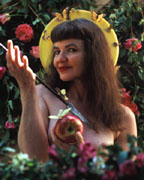
Joanna Frueh and Russell Dudley, Venus Verticordia 2005 (2004)
.
Photo after Dante Gabriel Rossetti's painting Venus Verticordia (1864-69).
I came of age as an art critic in the late 70s before I came of age as an artist during the early to mid 80s. I was living in Chicago and published my first articles in Artforum, Art in America, The Chicago Reader, the Feminist Art Journal, and the New Art Examiner between 1976 and 1978. My first performance took place at the Deson Gallery in Chicago in 1979, and from then into 1985 I performed (sometimes with my first husband, Thomas Kochheiser) where I lived. In 1986 I presented a performance at the College Art Association conference in New York, and from then on I have performed at many other venues. With the publication in 1996 of Erotic Faculties, a collection of my performance texts that includes a “portfolio” of self-portrait pin-ups, shot in collaboration with my second husband, Russell Dudley, both my performance and photo work became widely disseminated. I wrote and performed the pieces in Erotic Faculties between 1986 and 1994. Russ and I began collaborating on photos of me in 1988, and we shot the images that appear in Erotic Faculties between 1989 and 1992. So, while I was active professionally and creatively in the 1970s—from age twenty-eight to thirty-one—a significant body of my work, the photos, did not begin till midlife—age forty—and was not publicly available till I was forty-eight. Feminism helps to illuminate the complexities of my professional coming of age. First Wave, Second Wave, and Third Wave, as categories that bracket historical periods, that encompass both chords and discords of feminists as well as practices, ideologies, and individuals of significant difference from one another, and that leave out other waves and ripples prior to the nineteenth century and outside of Europe and the United States, are unwieldy and frustrating. Hannah, Holly, Janet, and I all belong in the categorical illusion of Second Wave, because of our birth dates.
While the Second Wave revitalizes and builds on First Wave liberalism—protection of autonomy and of individual choice—with the Second Wave’s focus on reproductive rights, and, as I mentioned earlier, sexual freedom, by the late 70s, and into the Second Wave’s “end” somewhere in the “post-feminist,” deconstructionist early 80s, Second Wave became identified with anti-porn and sex-negative attitudes. (Through the 80s and into the 90s, I generally supported the rights of people to make and view pornography. However, because of its increasingly abundant visual and moral ugliness beginning in the ‘90s, porn has lost much of my support.) Second Wave feminists certainly understood that sex is powerful and that, if women are to feel whole and truly human, they must define, determine, and enjoy their own sexuality, yet I have felt some feminists’ hostility towards the honest, intimate, romantic, and graphic expressions of heterosexual pleasure in my performances, such as Mouth Piece (1989). Even in 2003, when I performed The Aesthetics of Orgasm at a women’s conference in Belfast, a large portion of the audience strongly projected hostility towards me. I felt pain: that hostile portion of the audience was composed primarily of midlife women—my generation—and lesbians—with whom I have felt solidarity for decades. On the other hand, one of the most enthusiastic members of the Belfast audience was Myfanwy MacDonald, a transgender male of around thirty who was working on her Ph.D. in Australia.
Which brings me to my affinity with Third Wave Feminism, especially its celebration of feminine self-styling and women’s sexual directness. Granted, those attitudes have deteriorated into young women’s frenzied and witless displays of their bodies in the spectacles that Third Wave feminist Ariel Levy fervently critiques in Female Chauvinist Pigs: Women and the Rise of Raunch Culture. Nonetheless, I feel that I came into my sexuality and femininity in a Third-Wave way, specifically, a woman’s self-accepting, playful, and conscious display of her body; and I am honored when a young feminist art historian such as Maria Buszek understands the intellectual foundations of the feminine self-styling and sexual directness in my performances and photos. In her book Pin-Up Girrrls: Feminism, Sexuality, Popular Culture, Buszek states that “Joanna Frueh’s pin-up self-portraits . . . reference the complexities of both feminist history and sexuality that I hope this book illuminates,” and she describes me in the photos as “a fierce, midlife female whose selective, self-aware construction of the erotic intellectual defines the ‘feminist pin-up.’”2 This is a far cry from being characterized as an essentialist by some Second Wave feminists.3 I addressed that situation—the naming as essentialist, by deconstructionist feminists, of some Second Wave feminists who focused on the female body in their work—in my performance, given in 1988, Has theBody Lost Its Mind? 4 There I say, “Essentialism is seen as simplistic, a monolithic treatment of the female body, a restereotyping. . . . Certainly sexuality is socially constructed, but it is also . . . grounded in the facts that there is a logic to life and that if we avoid this logic, which includes love and knowledge of our bodies, we will suffer in them."5 I feel loved by Buszek’s words. Luminosity
I used to teach at the University of Nevada, Reno—I became Professor Emerita of Art History at the beginning of 2007 and am now Distinguished Professor in the School of Art at the University of Arizona—and in the student newspaper several years ago, a writer, having seen a performance of mine, declared that he had witnessed my “luminous sexuality.” If I am luminous, it is because you, luminous sisters, have let me see how you have fashioned your lives and yourselves, how you have done your best to love. Luminous sisters, Janet, Holly, Hannah: in our feminist allegiance, our feminist light, we repatriate the realm of love.
Notes
1. Joanna Frueh, “Beauty Loves Company,” in Nancy N. Chen and Helene Moglen, eds., Bodies in the Making: Transgressions and Transformations (Santa Cruz, CA: New Pacific Press, 2006), 19-26.
2. Maria Elena Buszek, Pin-Up Grrrls: Feminism, Sexuality, Popular Culture (Durham and London: Duke University Press, 2006), 14.
3. In note 147 of Thalia Gouma-Peterson’s and Patricia Mathews’s “The Feminist Critique of Art History,” The Art Bulletin, 69.3 (Sept. 1987), 344, the authors quote me and then write that methodologies such as mine “have been criticized for their essentialism and their re-stereotyping of woman as body.”
4. The first and only time that I performed Has the Body Lost Its Mind? was at the Theory panel, The Way We Look, The Way We See: Art Criticism for Women in the ‘90s conference, Los Angeles, CA.
5. Frueh, “Has the Body Lost Its Mind?” in Frueh, Erotic Faculties (Berkeley:
U of California Press, 1996), 115.
Joanna Frueh is a writer, an artist, and a scholar. Clairvoyance (For Those In The Desert): Selected Poetry and Prose, 1979-2004, a collection of her key performance texts, is forthcoming from Duke University Press.
Vanalyne Green
Feminism, Actually
I’ve decided to address the questions posed by Mira and Susan with what I’m thinking about now. I was in Judy Chicago’s first feminist art program (Fresno, CA) and then studied with Sheila Levrant de Bretteville at CalArts, and both Judy and Sheila were formative and life-changing mentors. But I’m in the middle of a conversation, mostly with myself, about what women’s lives have to teach us about feminism, actually. I remember in John Berger’s book about Pablo Picasso, he suggests that the Communist Party, of whom Picasso was a card-carrying member, didn’t provide a capacious enough aesthetic space for Picasso to contribute in the ways in which he possibly could have. The party, with its rigid and oppressive ideas of what could be and what couldn’t be art, failed him and therefore us. It’s not that I think this is true for feminism, but I’m wondering how women’s lives get lost – or if they really do – in the middle of feminism, as feminists. These questions aren’t active in my imagination, really, for myself. I am indebted to the feminist movement, or, rather, the women who fought it into existence. The junk, the psychological debris of relatedness, when it doesn’t work or hold, I chalk up to social systems that impoverish, deprive, etc.
But for a while now, I’ve not been able to blame the usual list of suspects when I look at the life and work of a woman who didn’t make it through: Maryse Holder, a writer a teacher, and explorer, in a manner of speaking: In 2002, while researching a piece about women’s video art for Feedback. Video Data Bank Catalog of Video Art and Artist Interviews (Horsfield and Hilderbrand, ed.) I stumbled on a review published in Off Our Backs of the first women’s video art festival, which was held at The Kitchen in 1972. It’s a generic one-page text, written by someone who obviously knew nothing about video and who seems to be puzzling it out as she writes. In the end she decides that women and video might go together: stay tuned, she says. Done quickly—off-hand, almost. And the author is Maryse Holder. We’re going back in time from 2002 – when I found Holder’s review – and forward in time, from 1972, when she wrote it, to 1987, when I saw a film at the New York Film Festival titled A Winter Tan, produced and directed by a team of four Canadians, one of whom stars in the main role of Maryse Holder. A Winter Tan is based on the letters that Holder sent from Mexico to her friend Edith Jones. They were published posthumously in the collection Give Sorrow Words. Holder had a thing for Mexican men and her letters home were full of sarcastic* and detailed descriptions of her sexual encounters with them, but not only.
When I saw the film it was at a time when feminist video and filmmakers, I among them, were still trying to parse Laura Mulvey’s 1975 article “Visual Pleasure and Narrative Cinema.” Yvonne Rainer had released The Man Who Envied Women, for example, in 1985, and here the female protagonist is never seen on screen. We talked about that. Rainer was playing with the conceivable permutations of Mulvey’s thesis, living inside the text and seeing how she could inhabit its feminist and theoretical challenges to the representation of women on screen. In that feminist environment, things mattered– how one represented revealed something about one’s values. They still do, but perhaps the community was less pluralistic than it is now, to put it simplistically. I was working on a video about baseball and was vexed about how to pose some questions about desire – in particular, I was going to tell a story in which lust for men in tight uniforms would be played out against a backdrop of gender politics and oedipal drama. But I didn’t want my “character” to exist off screen. And I also didn’t want to repeat ad infinitum the same setup I had seen hundreds of times: Anguished confessions by young women of sexual desire still housed in a body that’s groomed to be seen, read, scrutinized, and framed.
But A Winter Tan changed things for me, opening up other possibilities because Holder’s character, as portrayed by Jackie Burroughs, even while delivering explicit descriptions of sex, was matter-of-fact, with a mise-en-scene as unromantic as the interior of a florescent-lit bathroom: “He parted my cunt thoroughly and I swear it seemed as if he took a breath. It felt like a wet snake, very cool. I knew I tasted good and he had raved about my pussy… Back to my cunt. I was too grateful to be genuinely aroused….” Nothing coy here, and along with the description of sex, the reality of power: “I was too grateful to be genuinely aroused.” And no down time allowed in detailed sexual descriptions coming from Burroughs, who ventriloquized Holder in a series of pugilistic choreographies, her actress’s toned and slender body a character in the film, rather than the thing from which language flows. I decided that I had another way to represent desire and used similar tactics in my baseball tape, finished in 1987.
OK. We’re now in 2002, though metaphorically, I’m back in the 1970s, looking at early women’s video art for my piece in Feedback, trying to get a hold on how to write a synoptic essay about a favorite subject. I’m reading Holder’s 1972 prosaic one-page review of a women’s video festival and am stopped by the existence of Holder, a minor chronicler in the history of women’s video art and Holder the woman whose clear, mean, sad prose about her two stays in Mexico was adapted into a movie that I saw and that meant something to my life as a working artist. Here is where I should say that Holder never returned from the second of her two trips to Mexico . She was murdered. All of the people who give context to Holder’s letters – Kate Millet, in her introduction, Edith Jones in the middle section of the book, between Holder’s two visits to Mexico, and Selma Yampolski, who writes a sort of epilogue and lamentation, talk about Holder’s second trip being toward a known death. “These pages are the account of a woman on her way to death…” as Millet begins her introduction. And here is also where I should say that undoubtedly Holder’s violent murder plays a role in my curiosity and my concern about the lives of women in the middle of feminism.
Over and over, Holder mentioned her feminist self, her feminist community, as well as revealing her feminist analysis of gender politics. And, still! she marches to the theme, knowingly, of male rejection, male approval in a litany of doomed romances with men. Yes – it a motif occurs in the middle of powerful descriptions of life, sensuality, acute intellectual awareness – and yes, it is still there, this, by her own description, high-school like fixation of men returning a phone call or calling again after a sexual encounter: “…it hurts me to admit to myself that even if Miguel calls nothing can wipe off the stain and fear and cynicism of whore’s self-doubt that assails me….” I found a copy of Give Sorrow Words, the book of her collected letters, and read it, to see if it would help me understand better, this complex pas de deux between a woman’s life and her feminist self. To see if the producers and directors got it right, about Holder. And the book is great. Even better than the film. Not just about sex, after all, but also about loneliness, being stone cold alone in the world. About the funny little snippy competitive moments with other tourists – she gets it, the way power is played out, among themselves, by middle-class whites in a third-world country. About being an observer, and, perhaps, the necessary misery to be a good one. Also hilarious…. Ranging from an American’s chauvinist, snooty remarks about Canadians (her all-time favorite punching bag – how ironic that her letters were brought to life by Canadians) to in-the-corner-with-the-dunce hat moments of self-reflection on why she would scapegoat Canadians.
Revelation: she’s as good if not better than her male literary counterparts Kerouac, Burroughs, Mailer – meaner, wittier, wilder, and “fresher,” as Millet writes. And I find myself thinking – where does feminism fit into this story? I ask a question that I know is wrong-headed: why didn’t feminism save her? What is feminism’s relation to giving succor to women? I know, I think, these were naïve questions. After all, she produced, she wrote. She lived. But, worse, still and an unashamedly feminist question: why does no one know about this writing? I’ve met only two people who’ve read her letters. Are they as good as I think they are (yes)?: “My soul is paring down to a bone of insupportable truth. Every day I feel older and less desirable. I am a way station for new tourists on their way to a deeper scene. I am going to have to bypass the human friend as well. Every restorative kindness is penultimate to indifference. I dance with my shadow and, depending on the angle, and my own indifference, and my ability to dredge up confidence from some ever more remote credentials, I dance well or badly.” And this is where I am now: without answers, but wondering.
When I speak about Holder, my friends, such as Tamar Garb, reassure me that perhaps if it weren’t for feminism we wouldn’t have the one book of Holder’s that we do. True enough. Yes. I want to do more work about Holder, about her writing, and make claims for its powers in a public arena. Ironically, what little I’ve found has been through the traces of web communities. An anonymous reviewer on Amazon.com confessed (subsequently deleted) that she was married to a Mexican man who objected to her keeping the book, which she loved, in the bedroom. Unable exactly to expunge from the scene of conjugal bliss, she confessed that she kept it under the bed. My copy of the book is feathered with bits of paper and Post-it Notes to find my way back into particularly tawdry passages, such as, “Am sitting now in main square in the middle of a carnival dance from the vantage of a café, vainly hoping new life doesn’t overtake me before I can assimilate the old. And trying not to let it work into Lucio, but it is so beautiful to see and it will be over all too soon. Shit this new pen is too gross.” I will “end,” at this point, still a sign on a road map, with a list. A checklist of things I know about Maryse Holder and don’t know about what we owe each other, if anything:
- Holder was Jewish; She and her parents were hidden during World War II in France; Her mother was shot by the Germans in 1943; In Paris, at the end of the war, her father left her in a hotel
overnight, presumably to get food for them, and Holder became ill.
In the treatment for her illness she was left deformed on one side
of her face; She and her father emigrated to the United States when she was young; She was highly intelligent; She taught English literature in the New York University system
for a while; She wrote a piece (“ Another Cuntree: At Last, a Mainstream
Female Art Movement”) for Feminist Art Criticism: An Anthology, edited
by Raven, Langer, and Frueh; She was mortally self-conscious about her looks; She loved to dance; She went to Mexico twice and wrote a lot of letters to her friend,
thinking that the collection would make a book; She wrote devastatingly about the hierarchy of women tourists in
a foreign country; She fucked a lot of Mexican men, very young, but not only; She was jailed twice while in Mexico, on drug-related charges but
also related to having sex with an under-age man; She could write circles around male writers better known than she.
Listen:
“Got royally, horribly laid by a kitchen helper, plugged me with his monstrous prick three times, the last nearly rape. Boasted about his sexual sophistication, which consisted of knowing fifteen different positions from which to plunge his phallus into my hole. Three times in a row, much come each time, huge ass. Awful. The next night his jism was still working its way downstream. I am certainly pregnant now and will give birth to three bulge-ass kitchen assistants who will no sooner have left my bod than they will turn around and plug me in some endless Chinese fuck progression. Next morning, there he was again, so I said you really dig rape, don’t you, and managed to get my legs in between us to push him successfully off. Totally hung, I notice that he looks different. He is different! Who are you, I ask; why, Ricardo, he answers sheepishly. It was the asshole’s friend! I put on my horribly soiled digs and plunge out into brilliant, dirty, working-class Acapulco. God knows how I survived the day, though the memory of the sheepish would-be rapist managed to buoy me down the hill with ironic amusement. Of course, I still had Stan then, and skid row was a fantasy, nada mas. Now, $30 left, and my respectability is a tattered old dress only basted together.” She said she was taking a vacation from feminism; She said she missed her feminist scene; - She said feminism was a vision and an almost impossible one.
* Ironically, on most internet dating services, “sarcasm” is the most commonly used word to describe what men consider to be turnoffs in women.
Vanalyne Green is an artist based at the University of Leeds, UK. Her videos have shown at MoMA, the Whitney, and Videotheque de Paris, among other venues. Publications by and about, and interviews with, Green are in Performance Artists Talking in the Eighties and Women of Vision, M/E/A/N/I/N/G: An Anthology, and Feedback: The Video Data Bank Catalog of Video Art and Artist Interviews.
Mimi Gross
Decades later, the scars remain.
Confidence grows from adversities.
As a painter, as a woman, I believe all
women artists are natural feminists:
I am a painter. It is important to
do the work.
"Artists don't retire."
I had a working division in the 1970s,
cut in half.
By mid-decade I had stopped collaborating with my then separated
husband, (1975-76, we made an installation together with assistants, Ruckus
Manhattan) after this time, I emerged on my own: first, with a room-sized
installation for a 1976 Great American Rodeo Show at the
Fort Worth Art Museum in Texas; then, a commission to make tent and entrance
paintings for the just formed Big Apple Circus; and a commission to do
an installation in a room of a restaurant at Sixth Ave and 57th St;
by 1980, the beginning of the Next Wave at BAM, I did an 80-foot painted
set for the Paul Taylor dance company, costumes and sets for Douglas
Dunn and Dancers, and joined with the active NYC Collab artists in the Times Square Show.One
important and encouraging artist for me was Alice Neel. I had posed for
her and got to know her quite well. She said to me, "Why, Mimi,
you got over that fellow, didn't you?" and I said, " Alice,
if you got over three husbands, I could surely get over one," and
she laughed her loud, big way.
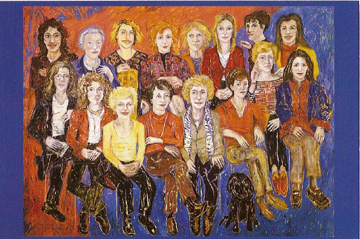
Mimi Gross, Arlene Raven and Her Artgroup Women, 2006,
oil and oil crayon canvas, 114 x 159".
Since childhood I knew Louise Nevelson, who was also my neighbor in Little Italy, and an encouraging older woman artist, who said, "Don't listen to anyone, just do your work!" I have always admired, and love, Marisol's work. I admired many works by women artists, especially the ones I knew: Elaine de Kooning, Mary Frank, Yvonne Jacquette, Elizabeth Murray, Yvonne Andersen, Louisa Chase, Suzan Pitt, Donna Dennis, Anne Arnold, Sarah Canright, Katharine Kean, Nancy Grossman, Gladys Nielson, the photographer Evelyn Hoffer, Sigrid Spaeth, Elfi Schuselka, and many choreographers, dancers, poets, all of whom have continued to do their work in a world that has somewhat changed to accept them.We have accomplished a footing in the professional world. In the art world, women artists, many well known and very strong artists, remain a minority. We must continue to maintain our integrity. It is our work that will, that must, speak and survive for us.
Mimi Gross is represented by Salander O'Reilly Galleries, NYC, where she will be in two group exhibitions in 2007: Flowers and Portraits; she will also be in Agents of Change: Women, Art & Intellect, Ceres Gallery, NYC, Feb. 2007. She is doing sets and costumes for Douglas Dunn & Dancers, Zorn's Lemma, Dance Theater Workshop, April 2007; and is a planning art consultant for a playground in Brooklyn.
1974 – Nova Scotia College of Art and Design
In my first year at art school I became conscious of feminism. I
remember a wrenching shift of my everyday life experience; (both the
work experience and the social experience). I thought; I could live my
life without compromise at least on certain levels. It seemed simple;
who you are is WHAT you do. No more nice behavior and no more nice girl.
Now I questioned stereotypes. The ‘personal is political’ helped me get through the social mine field of art school, where I watched a dreary power game of men who only saw women’s bodies. As a very shy 18 year old, I watched most of the women students and artists gain access to power through their appearance, or, as I have come to call it: through their ‘power of face.’ This was a most disturbing and destructive aspect of the art world being presented to me at NSCAD. I also observed that the women who had the strongest empowering effect on me were those who seemed to operate outside and beyond their “power of face.” A
few women come to mind: those who appeared to me to be living outside
of that intimidating male-dominated power structure. Each had a unique
framework, and each seemed to indicate an alternative new way of living
and working. Their effect on my confidence in work and life was tremendous.
For example; my work went from polite little brown cubist collages to
giant pink and green flying chicken bone paintings. All these women lived
their creative and social lives in ways that were clearly according to
their own invention.
1. Mira Schor
A spitfire of energy, she brought the ‘herstory’ from Womanhouse in
California. No more nice girl; but warm, aggressively joyful, engaged,
optimistic, serious, proud. Mira was like her work; I think of delicate,
elegant beautifully hand scripted diaries on heavily worked paper, and
great smoky, funny-scary monster paper works covering an enormous wall.
She brought the questions that challenged me to rethink my own past and
my personal relation to family, society and history started to shift
dramatically. Her NY Jewish European culture mixed with feminist politics
had a particularly deep resonance for me: for one thing, it helped me
get back to New York City! She brought consciousness to us sleeping,
unseeing girls at school.
2. June Leaf
Strong as an oak tree. Her powerful solid body bent over a huge
forge, her great feet and hands forging wild riddle-like sculptures
about the lives of men and women. When June made a drawing it was a
performance. Frequently it would grow to room-sized scale, and would
engage a room filled audience. Intensely serious and work focused;
there was nothing cavalier about June. All the little men talking while
June worked away, she embodied action over words. Commanding the paper,
steel, canvas, space, room; June demanded attention and I rehearsed
her strengths as life lessons.
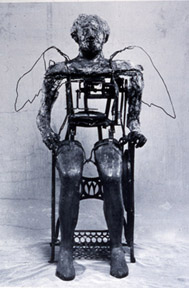
June Leaf, Angel on a Treadle, 1980, sewing
machine and mixed media, c. 58 x 60”.
3. Marilyn Lenkowsy
Her somber, stark pale face, and her style of honest, unadorned simplicity struck me as a new kind of sexy. The strong, straightforward and undecorated decorum in both her work attitude and personal mannerisms had the same liberating effect on me that June and Mira did. She was intensely, almost darkly serious, yet stayed always patient and warm in her teaching. I remember a wonderful night of art talk, consciousness raising and oyster shucking; all of us leaving with bloodied hands, full stomachs, and empowered spirits. Other women from the past who I had already revered took on new importance
at that moment of change: Janis Joplin, Emily Carr, Emily Dickinson,
Charlotte Bronte to name a few. And some other contemporary names in
those first years come to me: that pink cover of Lucy Lippard’s From
The Center, Judy Pfaff, Lucinda Childs, Ree Morton, Elizabeth Murray,
Yvonne Rainer. All of these women had a powerful influence over me
and they all showed me all the possibilities of being a woman artist.
I want to describe a few prototypical, particularly memorable works
by some of these women. These works resonated intensely at that time,
and have had a permanent affirming effect on me as a woman artist.
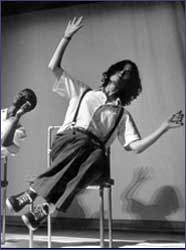
Lucinda Childs, performing in the opera, Einstein
on the Beach by Robert Wilson and Philip Glass, 1976.
1. I think of a show by Judy Pfaff at Holly Solomon Gallery (perhaps 1976?), a gallery installation that felt like being inside a fish tank. I felt underwater, and experienced line color and shape as physically suspended, floating, and in motion. The idea of being surrounded and touched by drawing and painting marks in air was extremely liberating to me in terms of how those fundamental elements could operate in a more traditional painting. Their physical presence as encompassing and commanding my view was thrilling and inspiring. The separate reality of a mark or gesture in a painting-separate from what the mark is describing- is still of central importance in my work.
2. I think of an extraordinary dance episode by Lucinda Childs in the opera, Einstein on the Beach, (which I saw in 1977). She sits on an ordinary hard-backed chair, and makes quotidian gestures and movements which through their rhythm, repetition and intensity, become a mesmerizing choreographed dance. Her body: pale, strong, unadorned and simply dressed in black pants and white shirt, looked transcendent and apart from the ordinary repressive sexism of everyday life. She admired the profound beauty and meaning of our ordinary body movements. And she transformed this ordinary body movement without resorting to making the body an object of desire. As she showed me that this kind of use of the everyday was possible, in painting and drawing I also tried to show how in its everyday real moments and rhythms, the city is at its most transcendent and extraordinary.
3. I think of a painting by Ree Morton of a fish that is at the same time a seascape. It is a close up still life of the fish’s body, and on the reflective fish scales one can make out a seascape. An oil painting thickly painted in a style that reminded me of Marsden Hartley. But Ree Morton adds to this double reality one more unexpected and meaningful twist: the body of the fish holds the body of the landscape, and around the outside edge of the frame, sea green painted canvas swags are draped curtain-like. This last challenge to how we perceive and depict reality, the dialectical issues about the relation between materiality and illusion in painting, once again had permanent impact on me. How I combine the real world and the world of the material of paint as equally important voices; the complexity and breadth in that visual duo, is still central to my ambition for my own work today.
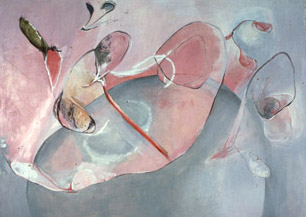
Susanna Heller, Flying Chicken Bones, 1975,
oil on canvas, 50 x 60”.
In writing this piece and thinking about those times, I find myself
reexperiencing some of the same intense emotions of that time: rage,
excitement, frustration, liberation, heart-sickness. I find that I
am experiencing a world that still produces depressingly similar effect
on me as a woman. This would of course indicate that women are still
operating in a nearly unchanged world where the hierarchy of white
men dominates, (with a new twist of right wing conservatism thrown
in).
Susanna Heller is a painter who lives in Brooklyn
, shows at Magnan Projects in NYC and Olga Korper Gallery in Toronto
, and is adjunct professor of painting and drawing at Rutgers, Newark
.
I am delighted and fascinated by the current resurgence of interest in 1970s feminism and the arts. It prompts me to trace my own trajectory as an itinerant feminist art historian in those years and to take this opportunity to credit a number of people, institutions, and publications that were especially important to me, including several that are lesser-recognized in current retrospective accounts of that time.
As a graduate student in art history at Columbia, I was swept up in the revolutionary impulses that seized the campus in 1968 and found myself turning away from my studies to see what else was going on out in the world. As part of this intense political education, I began to consider why my graduate art history training was not fully satisfying. I thought about the structure of all my previous education and became very interested in the alternative education models that were proliferating, inspired by the writings of John Holt and others who talked about a student-centered approach to learning. This led me to several years of teaching in a variety of alternative “free school” settings and to early experimentation with radical, and increasingly feminist, forms of pedagogy.
Finding myself in the Midwest in the mid 1970s, I was taken by friends to a talk by Miriam Schapiro that was billed as an art history lecture. Since my friends were all artists and I was the trained art historian, I went with a great deal of misplaced superiority that was wiped away with the sight of the very first slide. When Mimi, as I now know her, showed the famous fur-lined teacup and asked how many realized that Meret Oppenheim was a woman, I was floored. I had studied Surrealism for years and, of course, thought I knew that object quite well. Sadly, however, it had never occurred to me that Meret might be a woman’s name or that women really had much to do with that movement as artists. To put it mildly, Mimi had gotten my attention. And she asked if knowing that made any difference to our reading of the work. The interpretive possibilities inspired by that question have prompted complex avenues of thought. As she went along tracing the now familiar but then revelatory litany of the recuperated history of women artists, my next “aha” moment came when she showed slides of illuminated manuscripts and I realized, again, that it had never occurred to me while studying medieval art (and had never been mentioned by my professors) that nuns as well as monks worked in scriptoria as illuminators. Not to be dramatic about it, but this lecture changed my life. Not only did I learn new information, but more importantly, I realized that I had never thought to ask what might be missing from all that I had been taught. Women artists had been largely invisible to me, burgeoning feminist though I was. That was the real revelation. It had never before occurred to me that a name I did not recognize might be that of a woman. I had never noticed that women were not included in most of what I had studied. And, of course, as I learned more, it also became painfully obvious that artists of color, men and women alike, had been even more invisible.
Intensely hungry to learn more, I looked to books for help. But at that time I could find little to work with. I still remember vividly when I heard that there was a book coming that would trace the history of women artists that Mimi had so enticingly referenced. I literally stalked the bookstores until Karen Peterson and J.J. Wilson’s Women Artists: Recognition and Reappraisal was published in 1976. It was a remarkable book in a number of ways. First, it was written by non-art-historians (to my Columbia-trained mind, an extraordinary idea), a comparative literature professor from California State College, Sonoma (Wilson) and her student (Peterson), who had used a class project to do basic recuperative research and gather images of women artists working in the Western tradition as a way to share as much as they could about as many women artists as they could find. It was especially important because it included not only a rich range of information, bibliography and reproductions, but also several invaluable sets of slides (and here let me honor the publisher, Harper & Row for their foresight in this), so that the reader could pass this information on to others. I have kept these slides for years and they enabled me to put together my very first art history class focused on women and art.
In the meantime, shortly after Mimi’s lecture I heard that there was an exhibition of the work of Judy Chicago, who was artist-in-residence at the College of St. Catherine, a local women’s college in St. Paul. What I saw and heard in her accompanying lecture again blew me away. The work on exhibit was from her Reincarnation Triptych: Madame de Stael, George Sand, Virginia Woolf, abstract portraits surrounded by texts written directly on the wall that addressed the ways in which each woman’s ambition and creative energy was limited by psychological situations that Chicago associated with gender. Here was work that combined abstraction, still a privileged style in the mid 1970s, with personal and biographical narrative. In the following year, Chicago’s presence on the campus of this Catholic women’s college inspired the forward-thinking art department chair, Robert Clark Nelson, to see it as his responsibility at a women’s college to work to develop a curriculum inspired by the Feminist Art Program that Chicago and Schapiro had invented in 1971-73 at California Institute of the Arts and the subsequent work they did at the Feminist Studio Workshop in LA in 1973-74. This new program, developed by Nelson with departmental faculty including artist Carole Fisher and art historians Kate Johnson and Sister Judith Stoughton was titled the Feminist Arts Core Program. It was a heavily funded pilot project, intended to run for two years, although it was able to sustain only one year due to ultimately intractable conflicts between feminism and the institution of Catholicism. But it was an extraordinary year that brought together a curious assortment of students who, like me, fell into it from various corners of the country. Some were already enrolled students at the College. Many were not. Some were Catholic. Many were not. It was a studio-based program but one did not need to be an artist to participate. Conducted in a single large studio space that the College turned over to the program, it was taught by a triumvirate of amazing women—Fisher, Sister Judith and Sister Ann Jennings. From this, my first contact with Catholic nuns, I learned how extraordinarily willing some were to go quite far in examining and embracing feminism within their commitment to their faith.
The projects we did in the Arts Core were primarily content-based studio work. The idea was to make work quickly in response to narrative suggestions—e.g., make something that speaks of the position of your father in your family (the number of variously conceived heads behind newspapers was quite telling). Or think about “power over” and create a collaborative project. (My team of three created a short video in which we used a common text to link the gestures of women’s legs in three different situations—at a job interview, at a gynecological exam, in bed with a man.) This form of radical feminist pedagogy did not emphasize the traditional art school focus on medium, or material, or style, or even specific skills. Rather, we focused on content and learned the other as needed. More specifically, we focused on the content of our own lives as women and saw how the personal is political. Among many memorable projects that we shared in a consciousness-raising-as-critique format, was one by an artist whose name is sadly lost to me now. But I remember her well. She had been the person in the group who was always about to leave, always complaining, sitting outside the circle, making her presence felt through her discomfort and anger. In response to the assignment to “make something related to the presence of your mother in your life” she brought in a huge meat hook that she hung from the rafters to which she had attached a large block of ice. Throughout the critique, as we looked at one person’s work after another, sitting for long hours on a hard, very cold concrete floor, our discussions were punctuated by the sounds of pings, first occasional and then more frequent, as the straight pins she had embedded into that now melting ice block were dropping to the floor. It was a brilliant work, I thought, so evocative of the ways in which one’s mother is always present in one’s consciousness, as small pings in the background. And it was such a succinct metaphor for this woman herself, who had established just that same presence within our group. She had not studied ice as a sculptural medium, nor art historical models. It was a visceral, personal work, rich with autobiographical reference--feminist work, as we were coming to understand it.
I have always been sad that this program, so rich and complex and layered for all of us who participated (about 15), has not come to be recognized in the ways that the more well-known programs in LA and New York have. So many important artists and thinkers were invited as artists-in-residence to work with us—including Schapiro, Chicago, Betsy Damon, Harmony Hammond, Arlene Raven, Ruth Iskin, Lucy Lippard, May Stevens, and Marisol, among others. It was ground breaking, especially in the context of the Midwest and the Catholic Church in the mid 1970s. In fact, it is my desire to reclaim and record at least a bit of its history and to credit those who made it happen that has prompted these reminiscences.
And I need to go back to those slides that accompanied the Peterson/Wilson book because they also proved crucial to the subsequent directions of my professional work. They served as the core set of resources for the first feminist art history course that I taught at Franconia College, a small coed experimental college in New Hampshire that prided itself on progressive pedagogy. I had no problem convincing them to create a women-only art history course, modeled on what I understood of the work going on in California. To emphasize the paucity of resources available, even as late as 1976, if I had not had those slides, I would not have been able to initiate that class. One anecdote stays with me as an exemplar of that simultaneously excitingly progressive and still deeply misogynistic time. Feeling a sense of responsibility to the larger community as a women-only class in a coed school, the students and I created various events to publicly present something of what we were doing in the privacy of our classroom. One such venture was the creation of a huge banner that read “What would happen if one woman told the truth about her life? The world would split open.” It was quoted from a poem written by Muriel Rukeyser in 1971 that we had found in Martha Kearns’ book Kathe Kollwitz: Woman and Artist published by The Feminist Press (another crucial publishing venue) in 1976. It is a sentiment that was central to our class as we explored various consciousness-raising activities about secrets and truth-telling and finding one’s voice. However, our installation of that banner in the college cafeteria prompted vigorous denunciation and outrage among students and faculty who argued that they found it alienating to sit under such sentiments in a place where they had to go for their meals. The surprisingly virulent response to such a poignant sentiment about the costs of personal silence for women made clear to me how far we still had to go in engaging a broader audience in support of the most basic of feminist issues.
Those slides also served as the impetus for my PhD dissertation, which I later completed at Columbia. Included among the slides was the work of the Spanish-born Mexican Surrealist painter, Remedios Varo (1908-1963) who was relatively unknown in the US and within the scholarship of Surrealism. Beginning with those slides, I was able to find a trove of primary documents in Mexico City that became the source material for my thesis. This has led not only to my being awarded a PhD but also to greater visibility for Varo, who is now included regularly in many solo and group exhibitions as the contributions of women and Latin America to Surrealism have become much more widely studied. It also led to the publication by Abbeville Press of my book, Remedios Varo: Unexpected Journeys, that has been in continuous publication in the U.S. and Mexico since 1988 and that has also been published in editions in England, Spain, and Japan.
And the excitement I saw in that first feminist art history class led me to direct my energies toward radical pedagogy in the form of women’s education and ultimately to many involvements with feminist political activities and publishing over the years. It informed my tenure as Executive Editor of CAA’s Art Journal from 1998-2002 and my ongoing teaching at Moore College of Art and Design, the only women’s art college in the Western hemisphere. As with so many of my colleagues, I now work to get beyond the arbitrary and artificial binaries that construct gender as an either/or. But in the years of the 70s it was crucial to bring that single-minded focus to our enterprise, so that we could see what we had not seen and begin to ask questions that had not even been thought of. We have moved a great distance from the pivotal question about women and greatness that Linda Nochlin posed in 1971. But that has been possible, in no small measure, because she thought to ask it. Many others, both women and men, have joined her not only in looking for answers but, more importantly, for new questions in many fields related to art history: feminist studies, cultural studies, postcolonial studies, curatorial studies and visual cultures. It continues to be exciting to teach and think and work among that company.
Janet A. Kaplan is Professor of Art History and Curatorial Studies at Moore College of Art & Design in Philadelphia. She is author of Remedios Varo: Unexpected Journeys in multiple editions since 1988. She was Executive Editor of Art Journal from 1998-2002. Scholar-in-Residence at Bellagio, Italy, and recipient of NEH fellowships, she has been presenter, moderator and chair at many conferences and has lectured and published widely in the US and abroad.
Tom Knechtel
Sexy, Glamorous Feminism!
When I arrived at CalArts in the fall of 1972, I had virtually no experience with contemporary art. In those distant days of the school’s first decade, you didn’t need to send your grades to be admitted; you simply sent a sample of your work. For someone who had spent his time in high school ignoring his classes, this was a bright beacon. I had fallen in love with William Blake when I was fourteen. Blake’s directive to turn inwards towards one’s imagination, as opposed to outwards to the world, was intoxicating to a boy whose imaginative life was filled with Lewis Carroll, Narnia and the witty fantasies of Edward Eager. A child of the sixties, I took Blake’s belief in the power of the intuitive and the imaginative to mean that one didn’t need to actually work at anything one didn’t like. When it came time to take the SATs, I announced to my bemused parents that I wasn’t going to take them because Blake wouldn’t have taken them. While Blake’s work gave me permission to explore my inner landscape, it had the unfortunate (and certainly unintended by Blake!) consequences of encouraging me to wallow in my own ignorance and self-indulgence. I hadn’t explored the art world at all, hadn’t seriously considered what being an artist meant and was in fact clueless. When I arrived for my entrance interview at CalArts in the spring of 1971, I told Stephen von Huene and Nancy Chunn that I wanted to make illuminated books just like William Blake’s. They gently suggested that I might want to explore the illustration program. Fortunately for me, they didn’t turn me down; and I arrived for school in the fall of 1972.
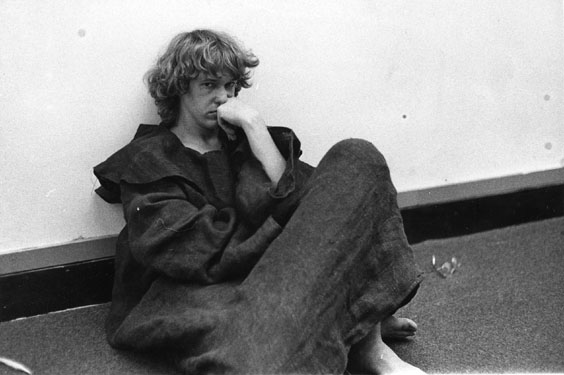
A grumpy Tom Knechtel in his second year at CalArts, 1973. I’m dressed as a monk
for a photo shoot for a painting I was making of myself as St. Anthony.
I felt as if someone had dropped me onto Mars. The school was perched on a dry hill in what was then a remote suburb of Los Angeles, with nothing around it. The building itself was an immense labyrinth of sterile corridors and vast studio spaces. In classes people were videotaping themselves wrapped in masking tape and trying to extricate themselves, or doing immense abstract canvases. Bewildered, I would look at art magazines in the library, pages and pages of Artforum and Avalanche with abstract paintings, performance art, image and text work. The only figurative work to be found there were the cold impersonal paintings of Philip Pearlstein, and I knew that I didn’t want to make anything resembling those.
No one at that point of course knew that the school was the most cutting edge art school in the country. It had only been in existence for two or three years and was being cobbled together from various aspirations, the looser teaching philosophies of the sixties and an awful lot of Walt Disney’s money. The art school’s faculty was made up for the most part of artists who had built their careers in New York, along with artists such as Stephan Von Huene and John Baldessari, California artists whose exhibitions were mostly in Europe. But under the dean Paul Brach, the school encouraged a diverse and exploratory program. He hired Baldessari to begin what was then called the Post-Studio Art program and supported Miriam Schapiro and Judy Chicago in starting the Feminist Art Program. And while the figurative, the personal and the anecdotal had dropped off the radar of the art world for some time, Paul actively encouraged younger artists whose work seemed eccentric and out of line with the prevailing aesthetics.
But those prevailing aesthetics were not to be sneezed at. It’s perhaps difficult for young artists now to understand exactly how puritanical the art world was then, a world in which if you did anything figurative or autobiographical, you would very likely be told that you were doing illustration. This was called picture-making, as opposed to painting–painting was supposed to be about painting and issues that arose from painting, not from your personal experiences or your sexuality. Painting was big, abstract, preferably minimal. I didn’t see anything that looked like what I wanted to make until I saw a small gouache painting in a student group show of a woman having sex with a bear.
In the painting a young woman with short dark hair was rolling in a barren landscape with a brown bear about her size, surrounded by various cactuses which seemed almost sentient with their probing spiked leaves. Clouds drifted overhead, painted with delicate streaks of gouache. The painting seemed to speak in the language of the dream, the personal journal – whiffs of sex and mythology, Indian miniatures and Sienese predellas emanated from it. Its power came from intimacy, tenderness, ambiguity. I fell in love on the spot.
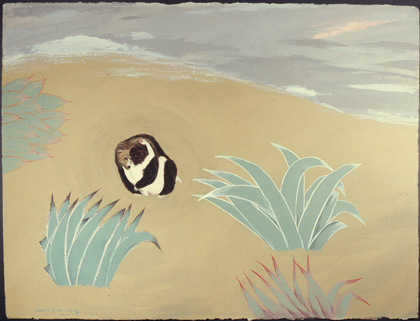
Mira Schor, Bear Triptych #3, gouache on paper, 22"x 30”, 1973.
The painting was done by Mira Schor, a graduate student who taught a class with the triumphantly defiant title “Picture-Making.” Mira had participated in the Feminist Art Program’s famous Womanhouse the year before and now had branched out on her own with this class that became an umbrella for the oddball painters in the school. She brought into the discussion of painting all sorts of material that was excluded from current discussions, material such as surrealist films and the history of clothing and toys, not to mention the use of autobiography and personal imagery. I felt that finally I had found a sympathetic context for my own work – and this context led me to feminism, which offered a congenial and exciting alternative to the prevailing mores of the art world.
Left. The Feminist Prom, 1974. Paul Brach and Lynda Benglis dancing. Photos: Michael Jang.
Right. Various straight male painters sitting on the sidelines wondering why everyone else is having so much fun.
The feminists for one thing just seemed to be having more fun. They were irreverent, questioning the sacred cows of the art world. This was when Lynda Benglis took out her infamous ad in Artforum, a double page photo spread showing off her admittedly fabulous body greased, naked and holding a large dildo at her crotch. (Take that, Philip Pearlstein!) They held a prom to raise money for the program – we all came dressed up in our best and danced, and they elected a Prince of the Prom (Jimmy Starrett the first year). The straight boys who were the backbone of the painting program would come to these dances and sit on the sidelines, looking morose and refusing to dance – perhaps it wasn’t befitting the dignity of a future de Kooning. But the women had a sense of humor about themselves, art, the politics of the art world, men and women. They were sexy – they were certainly willing to take on the meanings that sex generated, which to a young gay man felt like heaven after encountering the astringent aestheticism of 1970s minimalism.
The Feminist Prom, 1974. Jim Starrett being crowned Prince by Nancy Chunn.
I couldn’t quite crash the party and be in the program, but I certainly benefited from it. (Lari Pittman suggested in later years that young gay men such as us actually benefited more from the program, as we got all the permission but didn’t have to really pay any of the price paid by the women who went through the rigors of consciousness-raising.) And the faculty who taught in the program were generous and welcoming to me. In particular, Arlene Raven, who came to teach during my second year at the school, pushed me to use my sexuality, to do exactly what I’d been told not to: to tell stories about my own experience as a gay man and to find in those stories the content of my art. Arlene helped me to understand that in those stories rested a power – a power to understand oneself, to find one’s place in history, to deepen and complicate the content of the work. Arlene was my only openly gay instructor during my education, and her example – smart, brassy, direct, hilarious – further gave me the sense that the feminists offered a glamorous alternative to the dry scenarios that had so intimidated me when I first arrived at CalArts. But more importantly, Arlene and the feminists helped me to find my own sense of rigor – to learn how to harness my imagination to critical thinking, to link imagery and meaning in some effective fashion in my work.
Judy Chicago and Arlene Raven, 1973.
Perhaps this bildungsroman is a little too simplistic. The experience at CalArts was by its nature a rich, complex, contradictory one. Paul Brach, who produced exactly the kind of abstract minimal paintings that so flummoxed me at the beginning, approached my work with enormous sympathy and generosity, taking me under his wing and getting me into graduate school. (Indeed, I probably would not have become an artist if it weren’t for Paul’s guidance.) Pat Steir’s dictum that painting had to be about painting gave me endless hours of frustration but also arguably more to chew on in my studio than any praise I received.
At my final graduate review, John Baldessari said the only thing I remember anyone saying, perceptively pointing out that I was terrified to actually make something beautiful. And in my last year of graduate school, Elizabeth Murray came to teach. Elizabeth gave me my first experience with an abstract painter whose work I loved completely on its own terms, a thrilling experience. Up until then, I felt that I was trying to experience a language which was fundamentally alien to me; with Elizabeth’s work, I found my way into a kind of thinking that was about the skin of the paint, the weight of the color, the conversation that forms have with one another. And even more importantly at the time: Elizabeth reinforced the example of a working artist. Every time I went to see her, she was in her studio working. She didn’t hang out with the students – she worked. The message came through clear: you’re an artist, you’re in your studio working. Perhaps that’s the ultimate gift the feminists gave me: first, the permission to make art based on my own experience; then the finger pointing back to the studio and telling me to get back in there and get to work! I finally had the last part of the equation that eluded me when I was in the first raptures of love with William Blake. Blake taught me to trust my imagination – and the CalArts feminists taught me to stand up for that imagination and to work to back it up.
Tom Knechtel is an artist living in Los Angeles. He is represented by Marc Selwyn Fine Arts and teaches at Art Center College of Design.
Notes on Feminism in the Seventies
The seventies was a time of challenging notions like “art has no gender,” “women don’t make significant work,” and “woman are not tough enough to stand up in the face of criticism.” These notions were common on the West Coast where I was coming of age in the arena of the fight for civil rights and the Vietnam War.I am pleased to have this opportunity to review my experience as a woman artist in the seventies. Although I considered myself a feminist from an early age, by 1970 I had not yet made the connection between being a professional artists and a feminist. This was in spite of the fact that during the sixties when I was in school, I had no women teachers and very few role models. There were no examples of women’s work shown in my required art history classes. Being one of the boys was the position to assume.
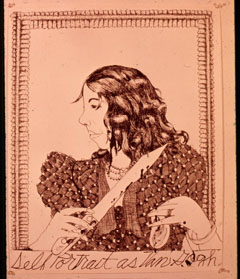
Judith Linhares, Self-Portrait as Van Gogh, 1971, ink on paper, 18 x 24”.
The realization that women were smart, talented, disciplined, and equally determined to succeed as artists was something I had to learn. That women could work together to gain more opportunities to exhibit, express their experiences, and challenge existing institutions to change their agendas was part of the spirit of the times. By the seventies, I was making painting, sculpture, and drawings that embraced the decorative, fantasy, narrative, and the “feminine.” I was motivated by taking aspects of art making that had been disparaged by instructors who held up high modernist standards. The worst insult you could receive was that your work was decorative. So, decorative was what I set out to be. I used alternative materials: rhinestones, hair, and black velvet. I depicted myself as Vincent Van Gogh, the infanta from Velasquez, and various mermaids. The use of narrative was also disparaged as it was considered a stratagem for minor art. I employed skills that women have used for centuries like appliqué, embroidery, and china painting. Much of the work I made in the early seventies was a kind of sculpture that bordered on the utilitarian. Some of the work took the form of furniture like tables and night-lights. This seemed to free me from many of the expectations that came along with making my paintings. These processes served me well for a period of time, but the desire to make paintings returned with all the attendant baggage of history. I began developing my own historic lexicon of women artists that included: Remedios Varo, Frida Kahlo, Toyen, Eva Hesse, and Louise Bourgeois.
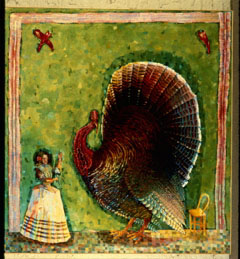
Judith Linhares, Turkey, 1977, oil on linen, 72 x 60”.
Collection: University of California at Berkeley.
The ritual of the women’s consciousness raising group cemented my newfound confidence and gender pride. I met with a group of women artists every month for about ten years. In the beginning we adhered to the proscribed agenda of consciousness raising, we would discuss our ambivalent feelings toward our mothers and relate various slights and exclusions and insults we had received. After a number of years this developed into studio visits and organizing shows. These shows were not always all women but included some men with similar artistic concerns. The women’s movement affected my life in many positive ways and made it possible through group action to exhibit, teach on the university level, and give and receive serious criticism. This process has made the value and importance of artist’s generated communities an important alternative to the more commercially oriented art world.
Judith Linhares was raised in LA, attended California College of the Arts, and has resided in NYC since 1980. Her paintings were in Marcia Tucker’s 1978 “Bad” Painting exhibition. She is represented by Gallery Paule Anglim and Edward Thorp Gallery. A survey exhibition, Dangerous Pleasures, traveled in 1994 and she was in the 1984 Venice Biennale. She has received fellowships from the NEA, Guggenheim, Pollock-Krasner, Anonymous Was A Woman, Gottlieb, and Adeline Kent. She teaches at the School of Visual Arts. An interview with her is in the Fall 2006 issue of BOMB.
Lenore Malen
I was not yet a feminist in the 70s. I was an art historian and art critic just beginning to make art. As a bystander here is an early memory. I was living in Washington, DC, in the early 70s and I attended a feminist art conference at the Corcoran. It was packed. You couldn’t move in the hallways. Alice Neel presented her work. Afterwards she was given a raucous standing ovation. She told the audience that this was the very first time in her life that her work had ever been recognized. It was absolutely thrilling. (As I recently found out, the conference was hosted as a concession to women artists who protested [and picketed] the exclusion of women from the Corcoran Biennial.) Hoping to contribute to your forum on the 70s in a meaningful way I've been looking through my old art magazines and I found a treasure trove of feminist journals from the 70s. It's a small random selection. I've moved four times since the 70s and so much has been lost or thrown away, including whole boxes of old art magazines. I don't know why these were saved and not others. This collection includes issues of The Feminist Art Journal,Womanart, and Woman Artists News, l975-79. It’s been many years since I’ve looked at these magazines, I didn’t know what to expect, but they reinforced what I remember about the women's movement in the 70s: democratic, courageous, political in the most fundamental way that involved personal lives and risky choices. Not ageist, not cool, not academic. Very sincere.
From my vantage point at that time, 70s feminism seemed to embrace anyone who wanted to have a voice and that went for artists and writers. Since this was the first time in history that women in large numbers had the opportunity to show their art, the feminist art magazines played a crucial and historical role in reviewing and documenting it. We mustn’t forget this. Some writers got started in these magazines, Carrie Rickey wrote “Women Shot Women: Films About Women Artists,” in l978 for Womanart, a lot of writers have been forgotten, such as its founding editor, Ellen Lubell. The magazines had the same format as Arts, ArtNews, etc., which meant features on living and dead artists, book and exhibition reviews, but the single thread that ran through virtually every single issue and every article was the basic problem of the absence of women from the world of art and art history.
In New York City where I moved in 73 I saw how the women's collectives: A.I.R., Soho 20, and others were shaping the feminist art movement—how indispensable they were. The feminist art magazines heavily featured the artists involved in these collectives. A.I.R. had a Monday night program where you could hear women art critics (but not necessarily feminists), such as April Kingsley and Roberta Smith, which I did.
As for the other feminist journal Heresies, I still own two incredible issues, #1 and #12 (The Sex Issue) and they can’t be summarized so tidily. Better to reproduce some of the contents here. Issue # 1 was published in January 1977, exactly 30 years ago, and you can see immediately how Heresies broadened the feminist debate and how the voices multiplied, ushering in the feminist discourses of future decades. I was amazed at how much it foretold.
From the First-Issue Collective:
The editorial collective of this
first issue of Heresies shares
not a political line, but a commitment to the development of coherent
feminist theory in the context of practical work. The time for reformulating
old positions or merely attacking sexism is past. Now we must take
on the most problematic aspects of feminist theory, esthetic theory
and political theory. We are not only analyzing our own oppression
in order to put an end to it, but also exploring concrete ways of
transforming society into one that is socially just and culturally
free. The role of the arts and the artist in the political
process is our specific arena. By confronting the very real differences
in our attitudes towards art and politics, which reflect those
in the wider feminist community, we have uncovered networks connecting
a broad range of forms and ideologies.”
Here are
some excerpts—with a Marxist slant— from the
January l977 issue. The two below are just a sampling. They can’t
fully convey the richness and variety in the entire issue. From “Towards
a Socialist Feminism” by Barbara Ehrenreich:
“Because
we see monopoly capitalism as a political/economic/cultural totality,
we have room within our Marxist framework for feminist issues which
have nothing ostensibly to do with production or ‘politics,’ issues
that have to do with ‘private’ life.”
And from “Juggling
Contradictions: Feminism, The Individual and What’s Left” by
Joan Braderman:
“I hope it is becoming clear how ideologically
messy liberalism really is from a post-humanist perspective in which
the individual can no longer be seen as the subject of history.” And
here are some titles of other articles from the same issue:
Tijuana Maid, Martha
Rosler
Women in the Community Mural Movement,
Eve Cockcroft
Women and Honor: Some Notes on Lying, Adrienne Rich
The Art of Not Bowing:
Writing by Women in Prison, Carol Muske
The Esthetics of Power in Modern
Erotic Art, Carol Duncan
Female Abstract Art: A Political Viewpoint, Harmony
Hammond
“Female Experience in Art” The Impact of Women’s
Art in a Work Environment, Ruth E. IskinAlso here are the names of some of the editors and
contributors to Womanart and The Feminist Art Journal.
From Womanart: Editor, Ellen Lubell, Art Director, Gyorgy
Beke, Associate Editor, Barbara Cavaliere, Contributing Editor, Gloria
Feman Orenstein.
Contributors: Lawrence Alloway, Mary Ann Gillies, Heidi
Blocher, June Blum, Elena Boorstein, Judith Brodsky, Charlotte Calmis,
Barbara Cavaliere, John Christie, Barbara Coller, Carol De Pasquale,
Jill Dunbar, Joyce E. Davis, Patricia Eakins, Peter Frank, Lorraine Gilligan,
Janet Heit, Robert Hobbs, Katherine Hoffman, April Kingsley, Marjorie
Kramer, Donna Lee Goldberg, Rosa Lindenburg, Lucy Lippard, Pat Mainardi,
Joan Marter, John Mohr, Sylvia Moore, LaVerne Muto, Vernita Nemec, Linda
Nochlin, Corinne Robins, Ce Roser, Barbara Rothenberg, Carla Sanders,
Miriam Schapiro, Susan Schwalb, Karen Shaw, Robert Sievert, Jackie
Skiles, Sylvia Sleigh, Nancy Spero, Joanne Stamerra, May Stevens, Michelle
Stuart, Judith Tannenbaum, Carolee Thea, Nancy Trachtenberg, Nancy Ungar,
Sharon Wybrants
From The Feminist Art Journal: Editors Cindy Nemser,
Chuck Nemser, Art Director, Geri Bachmann, Assistant Editor, Barbara
Jepson, Contributing Editors, Marilyn Coffey, Gloria Orenstein, Therese
Schwartz, Pat
Likos, Kathryn Ruby.
Contributors: Jennifer A. Martin, Carolyn Berry Becker,
Janet Catherine Berlo, June Blum, Olga Cabral, Annemarie Weyle Carr,
Mary D. Garrard, Jean Bergantini Grillo, Elizabeth Dugger, Toni Flores
Fratto, Frima Fox Hofricher, Harriette Frances, Noel Frankman, Joanna
Frueh, Ilise Greenstein, Rosa Hartman, Elsa Honig Fine, Phyllis Janowitz,
Jill Janows, Shelly Killen, Jerome L. Ridnitzky, Fay Lansner, Gail Lauzzana,
Joseph Leach, Patt Likos, Phyllis Lind, Judy Loeb, Ellen Lubell, Alice
M. Feinberg, Jane M. Thompson, Marsha McCreadie, Nancy Mowll, Carol Neuls-Bates,
Holly O'Grady, Judith Paine, Peter Payack, Marge Piercy, Brenda Price,
Melissa Reed, Annmarie Rousseau, Kathryn Ruby, Joan Ryan, Miriam Sagan,
Constance Scheerer, Sherry Solomon, Judith E. Stein, Gail Steslick,
Nancy Stevens, Mary Stofflet, Judith Trjoan, Sally Webster, Gilah Yelin
Hirsch
I became a feminist in the l980s. Feminism made me question every assumption I ever had. That kind of questioning has sustained me and is at the core of my current artwork. In 2000 I created a fictive utopian society, The New Society for Universal Harmony, which I’ve been exploring in various media ever since. The New Society is situated at the juncture of healing and myth and turns attention to our culture’s tendency toward blind discplineship and our overwhelming need to believe and to belong.
Lenore Malen is an artist and writer who lives in NYC. In 2007, The New Society will be shown at the Cue Foundation, NY, and Orion’s Belt ( Univ. of Reno ). Malen performed at Location One, NY, in 2006. The New Society for Universal Harmony was published by Granary Books, 2005. An article on Lenore Malen’s Fictions of Utopia by Gary Indiana was in Art in America, Feb. 2006. She teaches in the MFA Program at Parsons School of Design.
Ann McCoy
Feminist Art
In the seventies I was living in Los Angeles. Vija Celmins was in my consciousness-raising group and had graduated ahead of me at UCLA. I liked her drawing as a main medium. I also looked at the work of Frida Kahlo a lot. I was always interested in dreams and work rooted in personal experience and the artist’s unconscious. I also knew Sol Lewitt and loved his large-scale drawings. In around 1971 I switched from being a sculptor to doing large-scale drawings. I also had a life-changing experience. I had quit drinking and after a suicide attempt had gotten sober and had entered psychoanalysis. At the time I was very introverted and although I was in a consciousness-raising group did not feel comfortable around Judy Chicago and Mimi Schapiro. I was not a good acolyte, was very much an independent individual. I also had supportive relationships with men. I was working as a horse trainer and modeling at a department store. The money was something I needed to survive, but I was terrified I would be seen modeling sportswear at Bullocks. This would have been a killer in terms of feminist rules of conduct.
I found the consciousness-raising activity to be a mixed blessing. The 70’s were a wonderful time for women to dare to enter museums, galleries, etc. In Los Angeles galleries like the Ferris and Dwan were very much boy’s clubs closed to women. No women were in the art and technology show. With Marcia Tucker this began to change. The 1975 Whitney Annual I was in was the first to have a decent percentage of women. The feminist movement paved the way and forced the art world to confront its chauvinist shadow.
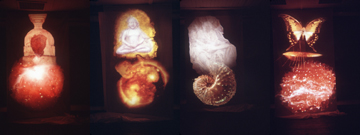
Ann McCoy, Conversations with Angels, installation, Majdnaek Muzuem, 2004
I feel my real feminist work began more in the 1980s. I began working on images from my dreams of figures like Isis. I do about twenty years of work on the divine feminine. As a Catholic, the worship of Mary was a big part of my life. I began to explore both the negative and positive aspects of the feminine in my work. In 2000 I did a series on my mother entitled “The Mad Mother Series.” This is some of the only work I know done on the negative mother complex. I am very interested in the “internalized mother.” This is a problem both sexes encounter. Melanie Klein and others have discussed this in terms of a person’s psychology.
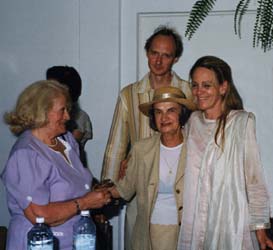
Ann McCoy with survivors at Majdnaek Muzuem.
Taking Nancy Spero’s example, I also did some works which celebrate women. In 2004 I did a huge installation at the Majdnaek Muzuem to honor the women in the camp who created an imaginary radio. “Conversations with Angels” was the first piece ever done in the camp dedicated to the women prisoners. Several came to the opening of the piece. These amazing women used psyche and spirituality to save themselves under horrible circumstances.
Ann McCoy is a sculptor, painter, and installation artist. She has studied alchemy and depth psychology for over thirty years in Zurich, Rome, and the US. Currently she is working with fairy tales with both alchemical and political themes. She is known for her large-format drawings and writings on psychoanalysis.
Brain Wave, A Sketch
In response to Susan Bee and Mira Schor’s questions I first fired off the briefest of outlines that I am adhering to in the following, but as it came time to write I found that what the subject really made me want to do was to ponder my family. I spent a few weeks realizing how many stories I know, as part of a distributed network of experiences. The stories have been formalized. They purport to describe what happened, but their function is the modification of emerging realities, to alleviate pain, to call up known and comfortable patterns, to create good feelings like pride and communality, to instill values in the young that allow the perpetuation of the known, be it a way to stagnate or a way to promote transformations. Stories may be about the past, but they are tools here and now. What does this have to do with the task at hand? As an artist, part of my job is to create a stock of stories about myself and my work. As a feminist, I am part of a distributed network of experiences. Which memories do I want to promote, and are there any I am sure of? What will they do to emerging realities?
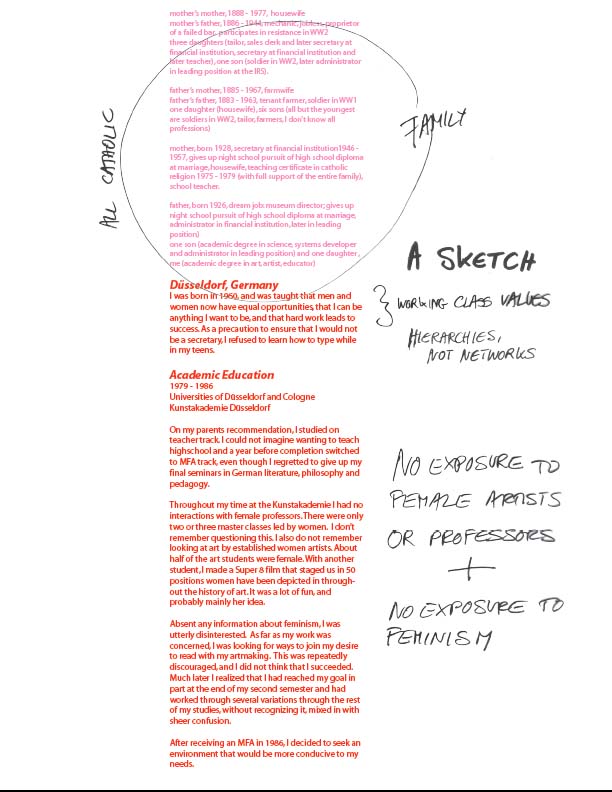
In 1969, as an undergraduate student in the art department of California State University at Northridge, I had an epiphany moment when a fellow student showed me a photograph he had taken. He asked each of his art instructors to pose for a photograph. They were five men, all in jeans and with beards. They all sat in a row in the same crossed-leg pose. The photograph was titled, The Artist Trying to Make It in the Artworld by Looking Like His Teachers. I was perplexed. Where was my place in this picture? Was there a place and a future for me as an artist? These were not my role models, but they did influence me. It was not until I got to CalArts that I had any women for my studio art instructors.
Photo: Ben Adams, 1973. The
Artist Trying to Make it in the Artworld by Looking Like his Teachers.
Left
to right: Walter Gabrielson, Adams, Bruce Everett, and Howard
Smagula.
In the early part of the 1970s I was an art student at the California Institute of the Arts where I received both BFA and MFA in Art. I was aware of the role of women artists in both academia and the art world and had questions about how this would affect my future as an artist. These questions and concerns led me as an undergraduate to join the Feminist Art Program, which was in its first year at CalArts. Because of this I was involved in the historic Womanhouse project. This experience of the Feminist Art Program was both wonderful and awful, challenging, and frustrating.
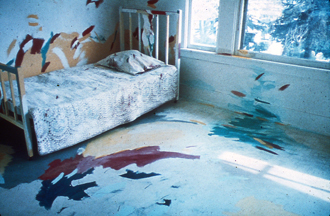
Robin Mitchell, room, Womanhouse,
1972. The walls, ceiling, floor, and furnishings were painted
with expressive and colorful brushstrokes. The room was ignored
for its perceived lack of political content.
It is important to see the Feminist Art Program and the awakening of the Feminist Art movement in the context of the times. It was a time of tremendous social and political upheaval. The antiwar movement, free speech, struggles of racial equality, sexual freedom, and environmental awareness were all part of a strong counterculture that fostered a fertile environment for the awakening concerns of women who were artists. The Feminist Art Program had a distinct humanizing effect on all of the people at CalArts, not just the women in the program.
I discovered a history of women artists that I was unaware of. This was exciting and life-changing for me. The program and the times were challenging and exciting. Where did I, as a young woman artist, fit into all of this? I felt a sense of responsibility and obligation to my future as woman artist. I had a legacy of feminism to act out of. I could not ignore it or deny it. I did not want to. I do remember many discussions and arguments with male artists trying to explain the questions and problems that feminism illuminated. Was it my job to enlighten many of the pig-headed male artists and art writers that I knew? I felt so frustrated by that wall that I seemed to come up against so often.An essential aspect of the Feminist Art Movement for me was awareness. Awareness about a history that had been marginalized and to the essential differences those women artists might visually or conceptually depict in their art. It also illuminated the prejudices towards and against women artists and tried to begin to right them. I saw my mother, the artist Libby Mitchell, paint everyday as I was growing up. She was my strongest role model for wanting to become an artist. She exposed me to art, museums and galleries, and taught me that art was something wonderful and important. She also instilled in me the power to be what ever I wanted.
During the 1970s I was inspired by the art of Eve Hesse, her experimentation with materials and her ability to extend an abstract language that communication physically, emotionally, and psychologically. I recognized in Agnes Martin the ability for abstract imagery to communicate beyond the simplicity of the image and allude to nature and spirituality. The work of Joan Snyder of the 70s spoke my language as she created a vocabulary of marks and strokes. I was physically struck by the power of Miriam Schapiro’s Ox paintings and I searched her out as a mentor. I think that I was most influenced by my women artist friends who were going through the same evolution and development that I was. I am grateful for the support, dialogue, example, and challenges that they offered me. It still continues. I am eternally grateful for my long-term friendships with Mira Schor, Karen Carson, Merion Estes, Ann Thornycroft, and Constance Mallinson. Perhaps you don’t recognize their names or know their artwork, and yet, each is an excellent artist who continues to toil at making meaningful and powerful art.
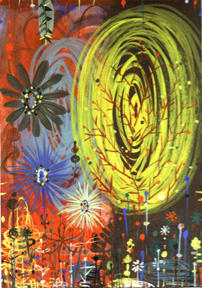
Robin Mitchell, untitled, 2004, gouache on paper, 10
x 7".
Have things changed? Yes. No. Some. There is a persistence of a veil of incomplete understanding of many women’s artwork. Women artists are still judged by a different standard than men. Middle-aged women who came to awareness during the beginning of the Feminist Art movement seem to be held to a truly different standard than younger women artists who have assumed many of the hard-won achievements as a given and a right. I feel also that there has also been some revisionism taking place when the history of women artists from the 70s to the present is examined. I cringe in anticipation that all of these exhibitions and panels that are about to occur will further mangle and misrepresent what occurred then and what feminism means to the art world.
Judy Chicago felt that women’s art was mainly expressed through “central core imagery.” I found this to be a ridiculous summing up of the possibilities of women’s creativity. I resented that Judy tried to mold the participants of the Feminist Art Program through her vision of women artists rather than to using that time to discover the directions that women might pursue and represent. Ironically, much of the artwork that I have made is symmetrical with a sense of physical entity at the core. Many of my images echo flower-like forms that oblique refer to female and sexuality. It gives me great pause for introspection and contemplation.I graduated from CalArts in 1974. I have continued to make art everyday since. I have had the reward of watching my imagery grown and evolve. I have also seen the art world change in many ways. I still wonder if my work is fully appreciated and understood by anyone but me?
Robin Mitchell is an artist living and working in Santa Monica, Calif. She received her BFA and MFA from CalArts. She is a recipient of an Anonymous Was A Woman Award in 1996, a 2006 California Community Foundation Fellowship, a City of LA artist grant, and a 1987 NEA grant. Her paintings will be featured this spring in solo exhibitions at the Jancar Gallery in LA and the Craig Krull Gallery in Santa Monica. She teaches at Santa Monica College and Pasadena City College.
My mother brought feminism home around 1967. Her first act as a liberated woman was to distribute the household chores to each member of my family, including my father. By the 70s, I knew that I would become an artist and was one of the very few kids in my high-school who self-identified as feminist. However, it wasn’t until the early 1980s as a student at Pratt, that I was finally introduced to the feminist art movement. I was fortunate to intern at Heresies magazine from 1984 to 1986. I have been profoundly influenced and encouraged by many, many different women artists over the course my art education and studio life. The sheer tenacity displayed by the following artists has been critical to my own production and sense of well-being. As a painter who has toyed with tensions between the social/political and the formal, I have looked to the exceptional minds and accomplishments of Fran Winant, Harmony Hammond, Louise Fishman, Jo Baer, Pat Steir, Dona Nelson, Ida Applebroog, Mira Schor, Sue Williams, Deb Kass, and Suzanne McClelland. As a founder of the lesbian public art project, Dyke Action Machine! (1991-2004), I have been fired up by the work of the Chicago Women's Graphic Collective, Mierle Laderman Ukeles, Erika Rothenberg, Lizzie Borden, Linda Montano, Sheila Levrant de Bretteville, Martha Rosler, Yvonne Rainer, Martha Wilson, Ulrike Ottinger, Valie Export, Barbara Kruger, the Guerrilla Girls, and Fierce Pussy.
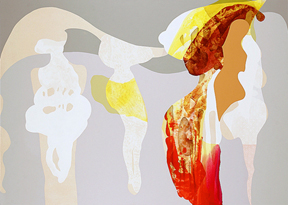
Carrie Moyer, The Stone Age, 2006, acrylic, glitter on canvas, 60 x 84”.
My current paintings are partially inspired by my own first discovery of feminist art and, in particular, goddess imagery in the early 1980s. As a young painter, I was consumed by the desire to find myself, a female artist, somewhere in Western art history. Books such as Merlin Stone's When God Was a Woman, and Erich Neumann's The Great Mother seemed to point to the possibility of a prehistory. In my newest paintings such as The Stone Age, the forms of goddess statuary, ceramic vessels and prehistoric instruments function as a wormhole to mid-century modernism. The paintings posit a feminist abstraction that is located in social as well as art history.
Carrie Moyer is a painter, designer and founder of Dyke Action Machine!, the lesbian art collaboration that was active from 1991-2004. Her paintings, public art projects and agitprop have exhibited and reviewed widely. She teaches at Mason Gross School of the Arts/Rutgers University, Pratt Institute, and Queens College. The Stone Age, was on display at CANADA, 55 Chrystie Street, New York City from Jan. 7-Feb. 11, 2007.
Beverly Naidus
My first encounter with feminist art occurred in 1973. My male art professors (we only had male ones at my undergraduate school) were attempting to groom me as their "queen bee," the exceptional female student who might actually become an artist rather than a consumer of art. I found this role distasteful and alienating, and didn't understand why my female peers were being disrespected in this way. One of these so-called non-serious art students had learned about the Feminist Art Program at the Cal Arts and the startling installations and performances emerging from Womanhouse. Buoyed by the excitement she shared about these West Coast projects, the female art students on my campus began to meet together. In our discussions, we vented our frustration about having no or few female role models as teachers in our art history courses or in the studio classroom. In response, we demanded our own budget from those in power to bring feminist artists to campus, mount a women’s art show, and organize women-directed and written performances of poetry and theater. It was a watershed moment. The energy we produced as a group was exhilarating. Two NY feminist guest artists facilitated a consciousness-raising session for the women art students. Although their intentions were well-meaning, it turned out to be more like a consciousness-shrinking affair for many of us. Their notions of what was liberated art and what was patriarchal were strange and uncomfortable. They critiqued the women students’ art show, saying that all the work that contained euphemistic “central” imagery was feminist and all other subject matter, be it landscape or portrait, was patriarchal. While I was deeply disappointed by this formulaic thinking, I tentatively decided to explore aspects of my unconscious through abstract images and by making literal gashs, slits, and holes in my canvases.
While a painting and drawing student in Provincetown, Mass., during the summer of 1974, I saw and heard my first lecture on the history of women's art, given by contemporary painter, May Stevens. Her lecture was a revelation. I saw work by dozens of artists who I'd never heard of and realized the extent of patriarchy's conspiracy to make women's art invisible. A year or so later, as one of two token female students in my Canadian graduate program, I painfully realized I needed to find a way to make feminist thinking fit. I was angry and frustrated by the way male teachers were dealing with me and my work. At the time, a few female undergraduate students and one lone female faculty member were discussing how they felt feminist thinking fit their working process, and this helped me to see that I could reshape the theories I had found confining. I decided then that real feminist artists need a range of strategies and tools, rather than the woefully limited and sadly essentialist repertoire of images and objects representing boxes, eggs, wombs, vulvas, and openings.
Publications such as Heresies and the ever-evolving writings of Lucy Lippard were also helpful to me in integrating feminist thinking into my work. Among the artists who interested me during this time were: Laurie Anderson, Adrian Piper, Hannah Wilke, Suzanne Lacy and Leslie Labowitz, Frida Kahlo, Alice Neel, Carolee Schneeman, Mira Schor, Eva Hesse, Martha Rosler and Ree Morton. My readings of feminist writers including Ursula LeGuin, Margaret Atwood, and Marge Piercy also had a big impact on the direction of my work at that time. Since then Starhawk, Octavia Butler, bell hooks, Joy Harjo, Magdalena Gomez, Leslie Marmon Silko, Alice Walker, Toni Morrison, and many other writers have greatly impacted my art, having a greater impact on my studio work than my viewing of visual art.
During my years in grad school, my work shifted from more coded and abstract painted images to more explicit, narrative work. I began joining text, audio, typed and hand written, with images and objects, and began to explore autobiographical topics born from memories, dreams and nightmares. An installation about bourgeois propriety and shame was Hanging Up (Some Laundry). It was my first public claiming of feminist subject matter. One image in the installation, a hastily scrawled cartoonish sketch of white pants with a red stain in the crotch, The Wrong Day to Wear White Pants, became the touchstone feminist image in the show. A readymade representing "I can't hold my skirt down around my knees" was another key piece of that installation. A later project (1978) that examined nightmares about nuclear war, THIS IS NOT A TEST, used a surreal bed as a metaphor for self-revelation, exposing both the personal trauma of growing up with nuclear bombs underground, as well as the collective trauma. The latter installation was reworked dozens of times until its last exhibit in 1991 in Long Beach, Calif. In 1983, after reading Joanna Macy, a deep ecologist and socially engaged Buddhist teacher, my work became explicitly audience-participatory. Once I understood that my testimonial work could solicit the stories of others, and potentially transform both the artist and her community, I began to unearth more hidden truths and contradictions of everyday life as my source material. I have continued to follow this process throughout my career, whether the subject matter was working 9 to 5, exploring stories of "otherness," healing body hate, decoding the lure and numbing aspects of consumer culture, or investigating the causes of environmental illness. My creative process has been born out of the liberatory strategies of feminism, and would not have happened without the feminist art movement.
As a final note, my pedagogical process, teaching art for social change,
has also been directly influenced by my understandings of feminism
and social ecology. (My essay on this topic is in the Jan. issue
of National
Women's Studies Assn. Journal, also refer to my essay in Malcolm
Miles' New Practices, New Pedagogies published by Routledge
in 2005.) Perhaps without being grounded in an anti-patriarchal and
anti-capitalist reading of the high art world, it would not have
been so easy to leave it, but the challenge has always been how to
create an alternative, an intellectually and culturally stimulating
community in our fractured subcultures, often overwhelmed by the
pressures of survival issues and the profound lack of time and energy.
As a preface I feel like it’s important to say that I was born in 1972 the year of Womanhouse and the year Valie Export wrote her feminist manifesto, as well as so many other feminist actions within/ without the art world. I was the only child of a single mother by the time I was 5, who by the time I was 8 had gone back to school for her doctorate in psychoanalysis. It was not a traditional childhood, and thank goodness, as it began my understanding of the intrinsic relationship between the personal and the political especially in regards to feminism.My upbringing involved lots of lessons in independence, exposure to all kinds of people, and a real sense of self reliability. My mother, not only through her own example, but also by giving me a great deal of responsibility molded in me a fierce independence and boldness. Growing up in the Midwest however I didn’t get much exposure to feminist art until college. But the foundations my mother had instilled made me readily sensitive to this great discovery.
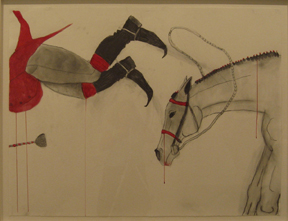
Rachel Owens, Getting the Fat Man off your Back, 2006,
graphite and water color on paper, 36 x 52”.
So when I embarked on my college career in 1990, I discovered the 70s, the era from which I too came into the world. Eva Hesse and Louise Bourgeois were my first feminist loves. Although their careers began before the 70s and Hesse died in 1970, their work and writings seem to be setting the stage. As a sculptor I was drawn to their incredible sense of materiality and form which especially in Hesse’s case is so integral to the content of the work. And in Bourgeois, I was attracted to her personal yet universal narrative that dissected the “home” and gender roles within. Hesse’s response to the rigid (and seemingly male) minimalisms of Judd and Le Witt made sense to me. A sense of letting the material and the work inform you as much as you inform it. The more conceptual and outwardly political work of Valie Export, Judy Chicago, Martha Rosler, and Cindy Sherman followed rapidly on my favorites list.
At the same time as I was discovering the feminist movement of the 70s, I was experiencing the post-punk rock movement of the early 90s known as grunge. Within this testosterone fueled world of rock there were several truly great “gurrrrrl” bands including Bikini Kill, The Breeders, Hole, and L7. These young women were bawdy, loud, strikingly articulate and sticking it in everyone’s faces. It was positively invigorating and prompted myself, another female and 2 males to start our own rock band. There was something very important about experiencing these 2 phenomena for the first time at the same time. An experiential visceral thing and an academic intellectual thing and discovering my own work they all informed each other in an important way.
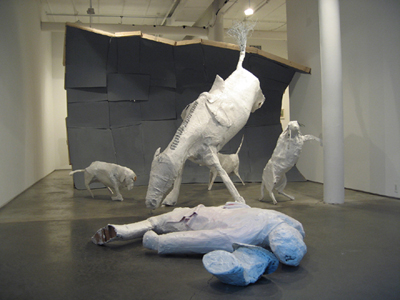
Rachel Owens, Overthrows, 2006, installation
view, plaster, wood,
cardboard, glass, burlap, glue, paint. Dimensions
variable/ all figures life-size, wave form, 16’ x 12’x
5’.
During graduate school and my first years in New York I was lucky enough to continue this education by working with Yvonne Rainer, Mira Schor, and Maureen Connor. Although my own work does not address gender specifically, it does discuss issues of hierarchy, political/power structures, and neocolonialism all of which derivate from a decidedly male construct. The work is still dedicated to the idea of the political and the personal being inextricably linked. This was learned at an early age through individual experience and reinforced by all of the feminist work of the 60s, 70s, 80s, 90s, and 00s that I have known.
Rachel Owens is an artist living and working in Brooklyn. She
has exhibited work at Ziehersmith Gallery, NY, Franco Soffiantino,
Turin, Italy, Lehman Maupin, NY, APEX Art, NY, and is in Empathetic at
Temple University in Philadelphia. She has curated exhibits in NY including One
Day, In a Day, Everyday at APEX Art and has an article on collaboration
in M/E/A/N/I/N/G Online #2. She is teaching sculpture at SUNY
Purchase and working on a collaborative artist-run storefront project
space to open this summer.
Born in 1959, I am one among many feminists who resides in that leaky region between the Baby-Boomers and the Gen X-ers. I came out as a Lesbian Feminist (and for a time, Lesbian Separatist) in Boston in 1981, which means I was also among a group of young women who were proud to call ourselves Feminists just as it was waning in fashion. Soon after, Feminism was embattled (again) in what I remember as “the Culture Wars,” and I can recall my resistance to the “split,” promising myself to invest in what I imagined was Feminism’s basic promise: to stand as a woman empowered to name all of the disparate parts of her life, and in doing so, take the first step in building bridges toward social justice. Perhaps it was naïve, but at the time, no more than the notion that I could be an artist. And even though I would come to spend a time alienated from the art world I now inhabit, my Lesbian Feminism never wavered. Then as now, it is not something that I have chosen to express in mass public protest, but rather something lived everyday, and as such, lives in my work.
In 1977 I was freshman at Albertus Magnus College, a small, Catholic, woman’s, liberal arts college in New Haven. Like my older sister, I was “allowed” to leave the northern New Jersey home of my WWII generation, Italian-American parents to go away to school. Only a few woman artists were formally introduced into my field of vision at that time: Georgia O’Keefe, Helen Frankenthaler, Louise Nevelson, and maybe Marisol. I lived in a very small world, and only had a vague idea of how small it was. I was looking for more, of something – but didn’t know what it was. I’d skip class to see art at the Yale Art Gallery in downtown New Haven. In 1979 I found Eva Hesse’s Hang Up (1966) installed there. It was riveting and inexplicable. That same year I found Judy Chicago’s Dinner Party through the popular press. Chicago’s work was accessible to me; I got it, the materials and the message. It was empowering. The Hesse remained compelling and I kept going back, trying to figure it out. I had no tools for understanding Hesse’s work and it made me angry. Perhaps, because of this I held onto it–and it held onto me for years. Twinned, these two works have come to represent the foundation of much of my work. The breadth of the two together has offered models of practice and language, as well as issues of class and audience I now pursue.
Some years ago I understood that the next best frontier for me as a feminist artist was to embrace the women who came before me, the ones who gave precedent to my work. As the other emerging woman artists around me tied their practice exclusively to important male artists, it was clear that the collective historical visibility of women’s work remained contingent on this “old school” sense of truth telling and solidarity. My experience was affirmed when I finally found and read Mira Schor’s “Patrilineage.” My naming of lineage is not a separatist operation. I easily name the men who have laid ground for me, especially in my earlier work. But since 2000, I have taken care to concentrate on the portion of my work that amplifies a connection to overtly recognizable Feminist tropes, in an effort to sustain an intergenerational bridge.
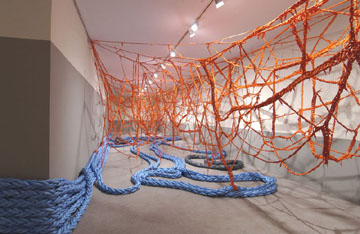
Sheila Pepe, Mind the Gap, 2005, Nautical towline, shoelaces, hardware and paint,
8 x 10 x 60 feet. Installed at the University Gallery, U Mass, Amherst
Along with Hesse and Chicago, here are a few, among the many women who have provided crucial precedent: Nancy Spero’s strategies of institutional infiltration; Judy Pfaff’s defining and complex use of two and three dimensional space, conflating the kinesthetic and visual into an unprecedented “full body” experience; Lynda Benglis’ keen understanding of the bridge between process installation and the decorative object; Kady Van Duers and Diana Davies, with whom I wove my first web during Sonia Johnson’s presidential campaign in 1984; Faith Wilding’s Womb Room (1972), who set out the original process and imagery of feminist intended crocheted installation; Donna Henes, who I have recently come to know as an important predecessor who performed the installation of webs in the 1970s; and finally Theresa Nigro, and her daughter, my biological mother, Josephine who taught me how to crochet.
For most of my life I’ve experienced a kind of generational dysphoria, especially as an artist. Most of my peers seemed adamantly positioned toward a promising career via one clear ideological affiliation or another. It wasn’t until I met Carrie Moyer in 1995 that I found a peer with whom could I share a complex argument concerning the state of art, feminism and our respective visions of the future. We’ve lived together, and have been in and out of each other’s studios since 1999. I am sure we share a great deal of influence, even while we support each other’s difference. When I was growing up in suburban New Jersey in the 1970s, am sure that Josephine had no intention to produce a Butch Lesbian Feminist Artist who, among other things, crochets. But that is no reason to denounce or hide her in the closet. Like many of us, and our professional art mothers, she was a special link in our historical continuum, a woman who contributed to our collective advance. As a Sunday painter and homemaker, visibility was not an issue for Josephine. Not like it is for her daughter and her artist colleagues. Service was Josephine’s guiding principle, and as much as I once completely rejected this call as a decidedly anti-feminist, I now know its great value. Directing one’s work in the service of a greater good is at the heart of social justice, and therefore, Feminism. And that the art world, no matter how progressive it perceives itself to be, no matter how well the objects it produces claim the ground of good politics, the mechanism of it will always benefit from some old fashioned feminist practice: women willing to work toward a more complex and equitable future.
Sheila Pepe makes sculpture, drawings, and drawings that are installations. Her new work Midtown will in the group exhibition "Radical Lace and Subversive Knitting" at Museum of Art and Design, in NYC, from January 25 through June 17th. She is the Assistant Chair of Fine Arts at Pratt Institute.
The late 1970s happens to be when I began working in the arts, lurching in a characteristically 20-something way from one job to another (including a gallery, a museum, and two non-profits). Printed Matter and Creative Time were the most important to me then, and still are. The artists/writers I paid attention to (or, remember having done so) in those first few years are similarly heterogeneous and more than a little random: Mierle Ukeles, Suzanne Lacy, Constance de Jong. Dottie Attie, Eleanor Antin, Ida Applebroog. Angry wit, a wonderfully compressed use of language, perfect timing and the courage of candor are things I now see they shared. But I thought abstraction just as important, as practiced, for instance, by Barbara Zucker, Pat Lasch, Cynthia Carlson, Dorothea Rockburne. Agnes Martin was a distant god, Jenny Holzer a hugely admired peer. I read Lucy Lippard, and Heresies.
That women could speak up for and about themselves seemed a gift and
a challenge to my generation. Sometimes, the leading spokespersons
expressed a sense of self-confidence that, however hard-won (and, probably,
heroically faked), was as intimidating and even a little appalling
as it was mesmerizing. The quantity of fey and abject art, not seldom
associated with questions of gender, that found success in the following
decades has made that self-possession seem, retrospectively, even more
important. Like everyone else, as I recall, I thought the ‘ghettoization’ of women’s work was a bad idea, and that the struggle for attention had, alas, been fought and won before I arrived on the scene. (In this connection, I should note that in 1977 I helped organize a show, for a long-gone downtown branch of the Whitney Museum, about domesticity as a subject in art by women; nearly every participating artist complained about the theme, generally because of what they saw as its belatedness). If only. It seem to me there isn’t a single important issue pertaining to life as a woman, in or out of the arts, that wasn’t broached, with incredible audacity and intelligence, by the work these and other pioneering artists and writers did at that time. The only caveat I’d add is that the question of sexual violence was almost always addressed anonymously and tendentiously, as a thing that had political but not personal causes and consequences; I think that’s
still largely the case, and leaves a lot of women speechless.
Nancy Princenthal, a New York-based writer, is a Senior Editor at Art in America. Her criticism has also appeared in the New York Times, the Village Voice, Artforum, Parkett, and other publications. She has an essay in Critical Mess: Art Critics on the State of Their Practice (Hard Press, 2006).
Carolee Schneemann
The 1970s were distinctively tough— I returned to NYC, with my English partner—the artist Anthony McCall, from what I termed my “Vietnam Exile” in London 1969-1973. It seemed all I had contributed in the 1960s was obliterated or repossessed. No money, no jobs, broken connections, I hadn’t the monthly fee to join A.I.R. Gallery. Within this dislocation, burgeoning feminist energies would burst into aesthetic conjunctions. The humanistic determinations of the 1960s had been ground down by the endless brutalities of the Vietnam War, the assassinations of our political leaders and popular culture figures, the murder of our own students at Kent State University .
Couples split, people moved away, liberal associations floundered, the erosion of agrarian communities increased. Feminist dynamics learned from the rigors of civil rights and grass-root resistances to reactionary political systems. In the 1960s, I had begun a secret, slippery research while in college to find traces of women artists and their displaced history. By the 1970s, I had begun writing a book on lost women artists. An eccentric, intensive research studying Paleolithic artifacts and sculptures (whose feminist values would soon be confirmed by the great anthropologist Maria Gimbutas, advancing the theories of Bachoften, Jaquette, Hanks, and others). My investigations ranged from the mutilation of Goddess statues to the destruction of ancient Mesopotamia libraries of women’s writings—mathematical premises, poetry, healing, medicinal and cosmological arts into the witchcraft trials (the means to appropriate lands, livestock, and waterways belonging to women). I accumulated files on the geographic traditions of clitoralectomies, on African fertility Goddesses, depictions of warrior and healing Goddesses. The basis of my self-determinations was not that women were depicted as subject, but that these artifacts had all been created by women. I was simply stealing back all that male culture had presumed could only be credited to his excluding traditions.
By the 1970s, there was an army of women emerging, deeply engaged in the discovery of the deformed, but now irrepressible history of women artists, scientists, linguists, biologists. Cultural history would be transformed. My history book floundered in the immensity of research, but I self-produced two radical, feminist, personal publications. Cezanne, She Was A Great Painter - Unbroken Words to Women - Sexuality Creativity Language Art Istory incorporated notes, essays, letters from the early 1970s. For Parts of a Body House Book published in 1972 by Beau Geste Press in England—a hand-painted edition of 75, and 300 facsimiles mimeo copies. I created a flow of essays and images, which put forward issues of sexuality, menstrual blottings, analysis of biases of gender, descriptions of the interactive erotic sculptures, Parts of a Body House and more!
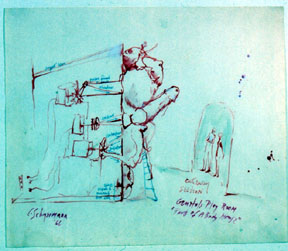
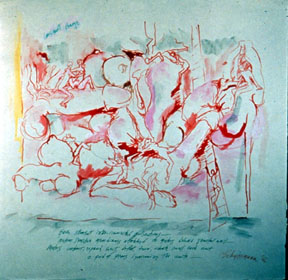
Left: Carolee Schneemann, Parts of a Body House - Genital Playroom I, 1966, watercolor and ink on paper, 26 x 26”,
Right: Genital Playroom II, 1966, watercolor and ink on paper, 21 x 18”.
Cezanne, She Was A Great Painter sold for $5.00 and went through several editions ensnaring my time with collating, mailing, and a search for distribution, which produced only rejections—it did not look like “a real book.” Rejections of the hand-collated book by bookstores was frustrating, but rejection of my work by feminist curators was an anguish. The installation of Up To And Including Her Limits was rejected from the major feminist exhibit, Making Her Mark, which traveled to various museums. Images of Interior Scroll were rejected by the Whitney Downtown for the exhibit, Mostly Nudes. Censorship of my explicit texts and body images remained both overt and covert. But feminist historians were supporting artists in our challenges to conventional depictions of the “feminine.”
From Parts of a Body House Drawing Book
Prick of the Week
In my native land there is a growing cult
called “The Genital
Reverencers,” also known as “Fuck Cherishers.” These
primitive and animalistic people believe fucking is their most rapturous,
expressive and integral act. They believe genitals are mysterious energy
sources and are dedicated to respect and even worship them; they find
genitals so compelling or beautiful in all their variations that they
are known to make imagery of them, sing about the genitals of a beloved
in secret language, and have dreams laden with sexual references! In
fact, they imagine the genital function of man and woman embodies some
electrical cosmic ecstasy pulse of all organic nature. Perhaps you
have heard of this cult? Due to the pervasive influence of “The Genital
Reverencers” I
am unable to understand certain of your English customs. Can Friends clarify
the following: Gentle Ghost heads a column ‘Cunt of the Week’—a
politician who accepts the starvation of 5,000 people with equanimity.
A couple signal to a cab. It does not stop for them. The man screams
after the cab “You cunt!”
Men and women are watching
a sport on television. A player drops a ball. The men yell “Cunt!
Stupid cunt!”
Some men are discussing another man who has
betrayed them; they detest him and sum up his character as “An
utter cunt.” My questions: is a "cunt" something
that makes men angry? or afraid? Does it stand for what they hate?
or what betrays them? Do English women call each other “You
cunt”? Or
do English women scream “You Prick!” when the taxi
won’t stop. Do English men who say “You cunt,” caress,
stroke, kiss, put their fingers on and in a real cunt?
Sincerely yours,
Cuntalee Snowball
London NW,
February 1971, Friends, London Even as a member of Artists for Cultural Change, I anticipated insipient
punishment for my essay “The Missing Pronoun” when I read
it to a meeting in the mid 1970s. I was trembling when I presented
this analysis of linguistic gender exclusion and its cultural “castration” of
women. (Anthony McCall, Carl Andre, Lucy Lippard, Rudolf Baranik, Jerry
Kearns, May Stevens, and others were present.)
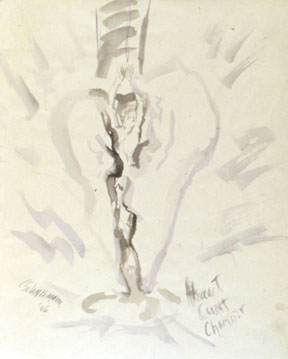
Carolee Schneemann, Parts of a Body House - Heart Cunt Chamber, 1966, watercolor and ink on paper, 24 x 18”.
THE PRONOUN TYRANNY – 1976
Women have special problems in realizing their own potential creativity. Every opportunity for learning may be opened to us but we have been prohibited from taking our work too seriously. We are nevertheless expected to excel (to measure up to men), and to put our excellencies in service of men and men's work. Our strongest, most personal impulses, dreams, desires, capabilities are to be channeled into realms described and established by and for men. Istorically we have been images but forbidden to be imagemakers. We may perform but not direct, follow but not innovate. Creativity has been a masculine preserve. A very few feminine mascots emerge. The full istory of women's innovative creativity has been demeaned, destroyed or buried away. Woman’s aggressive, risk-taking, adventuresome ego expression is repressed: we lack precedents.
Language itself excludes us constantly (each person will hang up his hat; each student can develop his potential; the dreamer and his dreams, etc. Primary female gender is assigned to forces or elements guided, controlled by men: the ship, She; our country, She, etc. Our self-confirmation (ego-energy) is further diverted by our lack of primary authority in the world: the judge, lawyer, doctor, painter, writer, engineer, priest, manager, director, etc. assume masculine gender. We join by special dispensation, by exception. All this subtly, thoroughly, discourages our free participation in advances of art and technologies; we come to expect a lack of certain capabilities in ourselves. Even success must mean we become a sort of “man,” a false female, an unlovable fiend. No matter how we freely choose, the "predestined" conventional role reappears. In the contemporary art world the most predictable fixity of the masculine pronoun occurs with insistent frequency among those artists of the so-called “fifties”: “men,” “boys,” “guys” riddle their conversation (and their writing) like bullets even when they are addressing or referring to women artists as well! Women may be among them by exception or special inclusion but the psychological-gender base of the language directs her to measure up to their heroic masculist mold. She must either constantly male-identify herself, privately recede, or protest. Women artists working among male artists is not an end to internalized sexist bias.
From Tape #2 for Kitch’s Last Meal (continuing Super 8 film: 1973, 74, 75, 76)
His full identification with us is so taboo, so repellent
that he cannot share, extend to us the pronouns for human being.
The current cock-eyed twist is this: he remains “cameraman,” you become “cameraperson.” Why
should he be “Cameraperson”? He hasn’t excluded himself
from the language by which his “natural” rights are perpetrated.
He is the chairman, you are welcome as chairperson. The distance is
maintained—snapping mother cunt trying to manipulate big boys,
kept at bay!
Artists with tender feelings for their female muse want
women artists to understand their exclusions are only loving distances
by which they are better able to see us in their own light. We are
a special sort of artist—slightly set apart from these men who
welcome us as fascinating guests in their domain.
“Man” is
the broken away suffix of “woman”; “male” is
the broken away suffix of “female”, “Father” is
the variation on “Mother.” His myths accustom us to think
of the female as auxiliary, pulled from his rib—phallic fecundity!
We have been shamed, humbled at their monumental obsfucations, silenced.
But they are born of us, by us, from us. We are the origin—the
source of production and creation.
“Seldom is his life time does
a painter receive the recognition accorded Anna Mary Robertson Moses.” (book
jacket blurb)
“The viewer can only observe each painting as a
manifestation of the artist’s ability to represent his own concern
through his technique.” (Soho News review of shows by
Janet Fish and Jane Wilson)
“There's an image in Meshes of
the Afternoon, often
repeated in stills, of Maya Deren standing at the window. It is a reflective
image; it is a calm image. It is practically an icon of a person looking
into himself.” (P. Adam Sitney, Film Culture pp. 53-55,
1972.)
The generic use of “man” to stand for male and female is sex biased because “man” also means male person and only by particular context a female person as well. The transaction is one of inclusion, implication, interpolation. Women have constantly to figure out when the use of “man” stands for human beings and when it means a male person. “Human” and “mankind” indicate both genders and are therefore neutral words despite the reoccurring suffix “man.” Books entitled Man and His Symbols, Man and His Image dominate art and istory titles; these automatically force women to double think; coerce our own verbal/ ego identity into a pattern which persistently excludes us even while assuming our moderate participation. All the texts which shape and develop our own conceptual capacities are couched in an unremittingly exclusive masculinization of gender. The weight of this bias is such that even some feminist writers feel they must address the reader as “he,” maintain the generic “man” for human being or risk trivializing or demeaning their subject.
Both Kate Millett and Germaine Greer, when I objected to their generic use of the masculine pronoun, felt that to use a feminine pronoun as well would vitiate their ideas, and a neutral construction would not be grammatically correct. Nevertheless many authors are confronting the conventions which their language perpetuates. Women have organized in publishing, broadcasting, on educational material, newspapers, to insist on the alienating damage to both female and male of gender exclusivity. The art world may be last among the communication channels to write with inclusive or neutral pronouns. In my studies on gender usage I find that women writers have less difficulty in suing the neutral pronouns, in making grammar gender-equitable. Such ease is more exceptional for male writers who too often awkwardly extend their thoughts to include both genders.
When a writer uses sex biased language, are the ideas negated? Can you trust political programs if the gender used is reactionary? Getting your genders straight doesn’t make a person a non-sexist. The least a writer can do—male or female—is set an equitable gender. If the context is sexist the ideational patterns are nevertheless opened to a woman as active principle. I don’t trust the ideology where I find gender imbalances—without exception—but I have to recognize the value of the information itself (i.e. almost all of Western literature!). Would you have any time left to work if you wrote a protest letter everytime you suffered from gender bias? Should you “correct”—mark up offending books to give the next person the idea? Until the common pronouns become equitable—that is, until the male is female-identified (and women can be self-confirming)—we will know that women are not equally and easily among them, but functioning as tokens, as ritualistic representations to ward off the larger menace to the male's ontological conviction of pre-eminence.
Gender fixity controls and regulates the authentication of information. Language has been used as a screen to keep our actual istory clouded, mythicized. Preistoric artifacts, papyrai, megaliths, mosaics, friezes, sculptures establishing the nature and quality of gynocratic cultures have been subject to distortion, mutilations, destruction or masculist interpretation to sustain patriarchal autonomy. In so far as translation is subject to interpretation, istories of ancient and remote cultures have been -- with some notable exceptions—strained through a masculist sieve. Until we return languge to ourselves we will not be able to conceive of our istory. Until we return language to ourselves we will not realize the degree to which our integrity has been deformed. Until we return languge to ourselves we will not make essential social transformations.
“Language is not merely a more or less systemic inventory of
the various items of experience.... but actually defines experience
for us because of our unconscious projection of its explicit expectations
into the field of experience... the ‘real world’ is to
a large extent built up on the language habits of the group.” —Selected
Writing in Language, Culture and Personality ,
Edward A. Sapir (University of California Press, 1949)
No man
can describe, assume, know what living within a phallocentric world
does to a woman. When he says he understands it is entangled with
his own condition, expectations, given rights, habits—all
meshed in the troubled and problematic societal network, but still
it one made by men in their primacy, enacting their realms of hegemony.
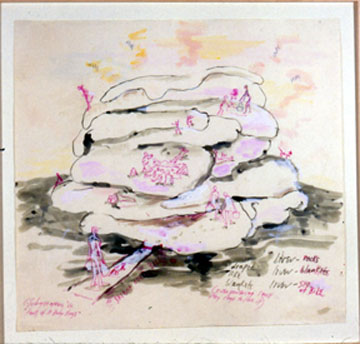
Carolee Schneemann, Parts of a Body House – Liver, 1966,
watercolor and ink on paper, 26 x 27”.
And so men have continued dreaming-women. Creating us anew for it must be true we have not, within their conscious memories, lived as definable, determined beings as they are to themselves. Istory, pervasive mythos, schema, language structures, ideological shapes of civilization—all this is defined by men, for men, about men but men don’t realize that. They somehow think we women are in all this by will as well!. We are visible, our lives merge within theirs. Then why do we insist who they make us is not who they see us as, who we feel we are? Why? They see who their mens-vision in its pre-eminence and defensiveness permits us to be. It is this we have to unravel: that men need LEARN TO SEE WOMEN BEING BY WOMEN
Men cannot imagine what it is to be for 2,000 years a women dreamt by a man. Men have continually re-invented/ invented women once they shattered and usurped evidence of her ancient integral culture. Man is not the “enemy.” Many men have such guilty, vague fears because they feel they must insist on their special insights to save themselves and do not grasp the range, dimensions of feminist change crucial to their own self-clarification and social relevance. So long as their natures are divisive they remain subject to an ever spiraling round of manipulations and coercions which keep them rooted in the exploitative systems they want to transform. Effecting their own clarifications involves learning from (listening to) women. (Just as their disciplines have been used by women to define and break-open their own subjugations.) The enemy is man-blind determination to continue to define woman and expect her to live within/by his slightly extended, adjusted perceptions of her. He often insinuates his political and social situation as if they are the same as ours; he deflects the lessons of our special repression with his sympathy and conventions. He wants social transformation but fears personal/domestic disruption. He wants women to function freely but resents relinquishing the hierarchical prerogatives of his sex and class. His resistance is most fiercely entrenched in stereotypes of domestic responsibility, and the use of language.
Is the degree of his resistance to feminist principles a measure of his unconscious fear that he will become even to some degree subjugated in the way the female has? That our equality would feel like subjugation? Is his control of the pronouns and their validating cohesions a manifestation of the age-old stereotypes: male equals culture, female equals nature; that the sanctity of the word is in compensation for the ancient creative sanctity of the womb? It has been the patriarchal cultures which determinedly sought to define and delimit the spheres of action, function and influence of the female. The origins of class oppression begin here with the violent, patriarchal revolution appropriating the woman and her children as property. These issues require a further presentation and should be investigated by anyone wanting to uncover men's power in the sexual dialectic. Women artists in particular need to work together to explicate and enlarge our personal situations as the energizing contexts from which a total re-examination of the tautologies of western culture will be possible. We need one another to examine our fears of a fully assertive feminist consciousness and to bridge the discrepancies between our creative work and our private lives among men with whom we must effect change.
Notes from 1974 for Women in the Year 2000 by CS
By the year 2000, no young woman artist will meet the determined resistance and constant undermining, which I endured as a student. Her studio and istory courses will usually be taught by women; she will never feel like a provisional guest at the banquet of life; or a monster defying her “god-given” maternal role; or a belligerent whose devotion to creativity could only exist at the expense of a man, or men and their needs. Nor will she go into the “art world”, gracing or disgracing a pervading stud club of artist, historians, teacher, museum directors, magazine editors, gallery dealers—all male, or committed to masculine preserves. All that is marvelously, already falling around our feet. She will study art istory courses enriched by the inclusion, discovery and reevaluation of historic works by women artist; works (and lives) until recently buried away, willfully destroyed, ignored, or reattributed (to male with whom they were associated). Our future artist will be in touch with a continuous feminine creative istory—often produced against impossible odds—from her resent, to the Renaissance to Paleolithic artifacts. In the year 2000, books and courses will only be called, “Man and His Image,” “Man and His Symbols,” “Art History of Man,” to probe the source of disease and mania which compelled patriarchal man to attribute to himself an his masculine forbears every invention and artifact by which civilization was formed for over four millennia.
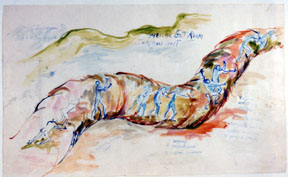
Carolee Schneemann, Parts of a Body House - Guerilla
Gut Room, 1966, watercolor and ink on paper, 34 x 22”.
Our future women will have courses and books on “The Invention of Art by Woman,” “Woman—The Source of Creation,” “The Gynocratic Origins of Art,” “Woman and Her Materials.” Her studies of ancient Greece and Egypt will reconcile manipulations in translation, interpretation, and actual content of language and symbolic imagery with the protracted an agonizing struggle between the integral, cosmic principles of gynocracy, and the aggressive man-centered cultures gathered as the foundation of Judeo-Christian religion in the Western work. Fifteen years ago I told my art istory professor I thought the bare-breasted women bull jumpers, carved in ivory or painted in fresco about 1600 B.C. in Crete, could have been made by women artists depicting women athletes. And I considered that the preponderant Neolithic fertility figurines might have been crafted by women for them selves—to accompany them through pregnancy and birth-giving. And I wondered if the frescos of the Mysteries, in Pompeii —almost exclusively concerned with feminine gestures and actions—could have been painted by women.
He was shocked and annoyed, saying that there was absolutely no authority to support such ideas. Since then, I have given myself the authority to support and pursue these insights. By the year 2000, feminist archeologists, etymologists, biologists, sociologists will have establishes beyond question my contention that women determined the forms of the sacred and their functions—the divine properties of material, its religious and practical formations; that she evolved pottery, wearing sculpture, fresco, architecture, astronomy and the laws of agriculture—all of which belonged implicitly to the female realms of transformation and production. The shadowy notions of a harmonious core of civilization under the aegis of the Great Mother Goddess, where the divine unity of female biological and imaginative creation was normal and pervasive, where the female was the source of all living and created image, will once again move to clarify our own conscious desires. The scared rituals of forming material to embody life energies will return to the female source.
One further change will be the assembling of pioneer istorians—themselves discredited or forgotten by traditional masculine authority. In the year 2000, they will be on the required reading lists. We will welcome Helen Diner, J.J. Bachofen, Michelet, Rilke, Elisabeth Gould-Davis, Jane Ellen Harrison, Robert Graves, Jacquetta Hawkes, Ruth Benedict, Robert Briffault, Erich Neumann, Marie de LeCourt, Ruth Herschberger, Bryher, Hays, Minna Mosdherosch Schmidt, Clara E. C. Waters (1904), Elizabeth F. Ellet (1859)! The negative aspect is simply that the young woman coming to these vital studies will never really believe that we, in our desperate groundwork, were so crippled and isolated; that a belief and dedication to a feminine istory of art was despised by those who might have taught it, and considered heretical and false by those who should have taught it. That our deepest energies were nurtured in secret, with precedents we kept secret—our lost women. Now found and to be found again.
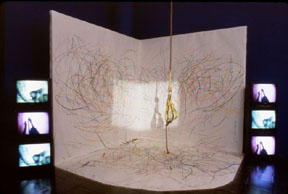
Carolee Schneemann, Up To and Including Her Limits, 1973-76,
Installation: crayon on paper, rope, harness, video monitors, Super
8 film projection.
Carolee Schneemann is a multidisciplinary artist who has transformed art, integrating the body, sexuality, and technology. Her video, film, painting, photography, performance art, and installation works have been widely shown in the US and Europe. In 2002, MIT Press published Imaging Her Erotics – Essays, Interviews, Projects.
The January 2007 symposium “The Feminist Future: Theory and Practice in the Visual Arts” at MoMA sold out so quickly after it was announced this fall that two months before the event even press passes couldn’t be had for love, money, or connections. This must be one of those moments when feminism is “in.” Or is it?
I chose to join the Feminist Art Program at CalArts my first year of graduate school. I certainly had no idea that I had signed on to a fraught identification with and a lifetime commitment to a political movement. Each decade of feminism that I have experienced has been uniquely challenging. Most of my public participation has taken place after the 70s but that decade seems to still hold fascination for anyone studying the history of feminist art. So what was it like for me as a young artist in the 70s? To answer this question is to begin the process of writing an autobiography, and to stray well beyond the confines of the art world. It is hard, makes me anxious, to compress or know what to triage from important years of my life, once asked to consider them publicly–even when I’m the one asking! I’ll just pick up a few threads of the tapestry, as they occur to me.
The Public
The first thing I want to say is that feminism–“Women’s
Lib” – was a widespread social movement that carried with
it a sense of general excitement, positive energy, sexiness, and humor.
If at the level of public visibility of the movement were outstanding
politicians like Bella Abzug, Barbara Jordan, and Shirley Chisholm–women
who stood firmly on their own two feet, spoke clearly and loudly, seeming
both fearless and witty–and coolly intelligent and beautiful
spokeswomen like Gloria Steinem, also at the core were many women around
the country in all fields and stages of their life, gradually understanding
that they were not alone as they questioned the greater political meaning
of their personal lives. Some examples of the widespread influence of Women’s
Lib: The
Mary Tyler Moore Show premiered in 1970 and ran for seven years,
for me bridging the period from college to my first teaching job.
Mary lived alone in small apartments, was dedicated to her work,
had an active social life, and close friendships. Here was a heroine
I could identify with, however improbably large the gap between Mary
Tyler Moore, the actress and myself.
Among the most treasured ephemera from my library is a copy of a special report issue of LIFE magazine entitled Remarkable American Women, published in 1976. This issue included wonderful photographs and well-written short biographic texts on 166 women from all fields, including an essay by Vivian Gornik on suffragist Alice Paul, then 91, in an old age home, but still working to pass the Equal Rights Amendment. The entry for Elizabeth Cady Stanton began with this wonderful anecdote: “When Elizabeth Cady Stanton was 10, she wanted to take a scissors and cut out of her father Judge Cady’s books ‘all the laws that make women cry.’” The compendium of fascinating courageous and colorful lives was very inspirational. And in LIFE! You couldn’t get any more mainstream than that!
The Personal
My older sister Naomi
Schor, a young professor
of French Literature at Columbia University, and her
friends Nancy Miller and Hester Eisenstein were in a consciousness-raising
group and I would hear about it and catch the ripples of their
excitement. The timing of their involvement with Women’s
Lib was exquisite since it coincided with their prime age of
sexual adventure and first years of professional struggle in
academia at a particularly important moment in the history of
theory. I confess that at age 20 I was often extremely resistant
to what they were saying: one rainy afternoon in Provincetown
in August 1970, my sister, Nancy, Hester, and I sat around the
dining room table for the whole day as they discussed various
forms of sexism in contemporary life while I resisted their logic – at
one point I used wet paper towels to demonstrate that ads for
such domestic items were not primarily sexist in their scripting
and targeting, but, more importantly, mendacious: the wet paper
towel fell apart! Why did I resist? Partly plain old sibling
contrariness perhaps but also awareness of the threatening nature
of what they were pointing to, something that would turn all
received ideas about the social order upside down – but
actually right side up.
Despite the resistance I put up to my sister and her friends that day, I had from early childhood been aware at a deep level that the world did not have an easy place for women who valued their minds at least as much as their bodies, and this injustice burned through my initial fear of how feminism threatened to turn the world upside down. I came to see that this was precisely its importance, that it was perhaps the most universally important and potentially transformative movement of liberation.
The example closest to home was my parents’ art and my mother’s experience of widowhood. In the 1950s in New York, my mother Resia Schor painted and exhibited abstract gouaches in a style reminiscent of Guston. When my father Ilya Schor died in 1961, she was fifty years old and had two daughters, eleven and seventeen years old. She had no other family. Much of a very active social life came to an end because it had centered on my charismatic father, even good friends treated her and us differently, giving me unpleasant but formative experience of the fragile social space a woman alone occupies in a patriarchal culture. It never occurred to her to look for another man to help her support her children: instead, figuring that you couldn’t make a living from painting, she took up the tools of my father’s trade as a silversmith, jeweler and creator of Judaica, transferring her abstract, modernist aesthetic from the soft medium of paint (and the arena of “high art”) to the hard medium of precious metal that challenged her forms in a more powerfully creative direction. She transformed her grief into a new art form and established an independent life through her work. And the deeply satisfying nature of her work, its material sensuality, its visual complexity and sculptural beauty, while it could never replace my father or reconstitute the loving wholeness of our small family, nevertheless was a new and powerfully positive force in my sister’s and my life, and in her life.
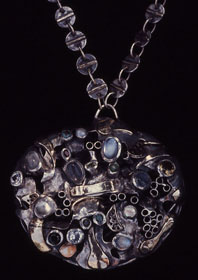
Resia Schor, The Moon, 1967, silver, gold, with
sapphires, moonstones and silver solder. c. 3 x 2 ½” .
The feminist content of this living role model was not lost on my mother. In "Carrying on an artist–jeweler's work," a 1969 feature article about her by Lisa Hammel in the New York Times , she spoke about her work, “I absorbed his methods, his techniques, his way of mixing silver and gold and his sculptural forms …but in working I went away from this, and because I am a woman and a different person, I created something which is personal.”
I have noticed that, of my young women students, the women most predisposed for feminism are the ones who have identified with something valiant in the life of their mothers – the mother who brought them alone up after a divorce, for example, or the working class mother and grandmother running a seamstress business in the basement – especially if the gendered aspects of the obstacles these women encountered were made clear to the daughters by circumstance.
Feminist Art Program at CalArts
I was a student in the Feminist Art Program at CalArts
from 1971-1972, my first year of graduate school. I worked on the Womanhouse project,
which opened in February 1972. For the month that Womanhouse was
open to the public, there was always a group of women from the Feminist
Program on site to give tours. One day when I was there, a number of
middle-aged ladies from the neighborhood came by in their housedresses.
As our little group of young feminist art students realized that we
were approaching Judy Chicago’s Menstruation Bathroom,
filled with feminine hygiene products and “bloody” tampons,
we melted away, leaving these ladies to their own devices. Later, they
came to find us and laughingly chided us for thinking they would be
embarrassed. I realized how much we were still girls while they were
women, and also how one should never underestimate any audience for
art.
In Feb.1972, The West Coast Conference was held at CalArts. In a March 2, 1972 letter I wrote:
There were at least two hundred and fifty women artists in one room from twelve hours Saturday and Sunday, showing slides and slides of work, talking, forming consciousness raising groups and discussing gallery and museum business, hiring practices etc. It was really an amazing weekend and even more so for the many women there who were older than me or you, who had disappeared into their homes and studios once they were out of school, who had been discouraged, who had been isolated, some of them had never shown their work to anyone for ten or more years. They were really moved. And the work was good. […]
It was an electrifying event and a revelation of previously hidden art practices. Women many of whom had probably never spoken in public showed slides of work that in some cases they had never shown to anyone: I particularly remember a woman who painted on paper with nail polish. I don’t remember the image. Today nail polish would be just one more predictable component of what I call “Recipe Art,” “Something from culture + something from art history + something appropriated + something weird or expressive = useful promotional sound bite.” That day all tropes were fresh and the energy emanating from all these creative women –their excitement, ambition, and fear – was so great I felt that a city could have been lit up from it. At one point I ran all the way to my dorm room, up and down stairs indoors and out, not fleeing so much as propelled forward by the intensity of the gathering.

Mira Schor, Fan, ink and medium on rice paper, 1976, c. 9 x 6”.
I began the 1970s doing autobiographical paintings that I called Story Paintings. It was one of these that Tom Knechtel saw at CalArts in 1973, part of a group of paintings detailing and revealing to the community at large the development of my sexual life. I was already working in this narrative and symbolically representational manner when I was exposed by the feminist art movement to related works by Frida Kahlo and Florine Stettheimer: in a way, learning about their work, which I loved, allowed me the freedom to stop doing that kind of work. A slide lecture by Joan Snyder played a major role in providing new models for greater experimentation with painting and drawing marks and non-representational space. Other influences came to the foreground, including work seen earlier, before I went to art school, for example, the work of Hanne Darboven, outside the frame of feminism, nevertheless so tied in, seen in retrospect, to my tropism for representing “écriture feminine” but also to conceptual art and language as image: I had first come upon her work in a show of multiple framed small works of handwriting-like abstract scrawls in the elegant uptown premises of the first Castelli Gallery on 77th Street. Lawrence Weiner’s early conceptual manifestos had made a big impression on me when I saw the Information show at MoMA in 1968. A few typewritten words on the wall were at first a poke in the eye of everything I had held true about art, but again, the permission to grow in unexpected directions burbled under the surface. Sometime later I had pondered the mysterious trail of boots in photographs by Eleanor Antin, also seen at MoMA, in the Projects space that used to be on the way to the modest and cheap cafeteria off the garden where I could spend a lot of time as a young artist with a $15 a year student membership.
In the mid-70s, a few themes came together: the image of the dress as an empty vehicle for femininity, which I saw as a free-floating identity outside of the individual woman, that she could put on or take off (*I got a psychological questionnaire in the mail from a woman doing some kind of sociological survey of feminism – one was encouraged to mark contradictory identifications and I sailed along until I got to the word “feminine.” I could not mark it because of the baggage of oppression, the trace of the word “ninny” in “femininity.” So I asked my mother, “Am I feminine?” Yes, she answered, so I checked it off with all the other contradictory words); the image of my handwriting as a less figurative representation of self; the shape of the fan, or a V shape going up as an abstraction of what I had found interesting in figuration and the dress shape; and ink on rice paper made transparent by medium, as a fragile embodiment that reflected how I saw myself at that time, in my twenties.
The idea of the dress as the subject of art was very much in the air. I had thought about becoming a fashion designer when I was in my teens, but in making lots of drawings of dresses, I came to realize that I was interested in drawing not the fashion business. In the Feminist Art Program at CalArts we had done consciousness raising sessions exploring all aspects of female experience for use in high art. The idea was in the air without one’s necessarily knowing specific works: I didn’t see Judith Shea’s spare sculptural works referencing clothing until a bit later in the decade, and only when I met Maureen Connor in the late 80s did I learn of her earlier work with clothing and cloth as sculptural material, as well, even later, of the work of Rosemary Mayer in the same vein of imagery.
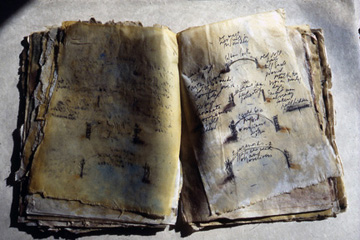
Mira Schor, Book of Pages,
mixed media on rice paper, 1976, c. 12 x 20 x 1”.
I began to work with language as visually articulated in the beauty of my own handwriting as image. I was interested in exploring the idea of women being filled with language – thoughts, dreams, conversations, diaries, readings. Book of Pages, 1976, was made when I was teaching at NSCAD in Halifax. That school's significant historical involvement with language-based conceptual art was a crucial influence layered over the important presence of Fluxus at CalArts. My idea was to do a big work, but not a big work: large in ambition but not in size. It was done in a provisional way, a few pages at a time, glued together as they went, not very scientifically, without a major plan. It was done when it was done. The text is diaristic, intensely personal, about my unrequited love for a particular man, but made with an awareness that it was so much like so many other diaries of that type and also that I was reversing the traditional gendering of the artist's muse.
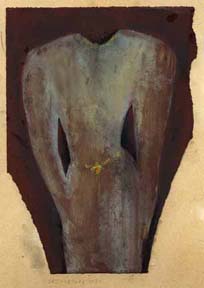
Left: Mira Schor, Empty Dress,
gouache on paper, 1974, 7 ½ x 11”.
Right: Mira Schor, Dress Book, “Angel,” mixed
media on rice paper, 1977, 56 x 15½ x 6”.
In 1977 I merged the image and form of the Empty Dress and the book in the Dress Books, which represent the culmination of these threads of my work. About 5 feet high and hung about a foot off the floor, these figures were meant to be approachable to the viewer: you could turn the pages of the woman and try to read her, but the illegibility of my handwriting prevented full understanding. Dress-shaped, layered, centrally constructed, personal via diaristic writing, sexual via materiality and textuality, incorporating the feminist art trope of the dress, the emphasis on process characteristic of 70s postminimalism, these works still seem to me like archetypical 70s feminist art. However, the canon of 70s feminist art was set in place by 1980 and it has proven to be as fixed as the first (male) canon had been: the current reexplorations of this period, while of great value and interest, especially for younger artists who may not have seen much of the work, inevitably still leave out much significant work of the decade.
I had started my work as a feminist artist as a student in 1971, the Dress Books were done in 1977, so only six years had passed, but the history of the first phase of feminist art in America was already over. That is the life span of an art movement. Just then, around the time that Marcia Tucker curated the Bad Painting show at the new New Museum in 1978 and Cindy Sherman’s Film Stills were shown at the Kitchen in Soho in 1980, the art world changed radically–studio-based value systems of materiality and process were replaced in favor of photo-based institutional critique, 70s American feminism was negatively labeled as essentialist, the country at large was gripped by culture wars, which included all-out backlash against feminism. I immersed myself in new discourses and debates, began writing about art, started M/E/A/N/I/N/G with Susan Bee and found that working as part of a feminist duo was much more effective and bearable to me than a larger collective.
Coda: I attended the MoMA Symposium “The Feminist Future: Theory and Practice in the Visual Arts” at the end of January 2007. A few impressions are significant to the moment/the movement. The strongest presentations for me were those that were performative rather than academic: the performances of Coco Fusco and Martina Abramovic, however much one might quibble about aspects of their content and political position, and those art historical presentations that did not collapse into the politesse and obscurity of fashionable theory, that did not merely refer to what has been canonized as important about the early days of the feminist movement, but actually showed the audience less well known, more raw and lived material from the time. For example art historian Richard Meyer showed scans of early 70s radical feminist and gay magazines such as Double-F: a magazine of effeminism, as well as PBS news coverage of the response to a 1972 exhibition by Anita Steckel of collages and drawings in which the male power structure was symbolized by erect penises. The power of ordinary people discussing the meaning of this imagery – not to mention the fact that it was shown on TV, whereas recently PBS digitally pixilated explicit sexual details of 18th century French anti-royalist cartoons – this was the thing itself. It exemplified the kind of radicalized and radicalizing expression of personal and political truth that I remember about the early 70s.
Such expression is often a double howl of pain and pleasure. And the freedom to express truth even darkly is, as is evident and performative in many of the art works, ephemera, and recordings of the feminist art movement, a living expression of joy.
Mira Schor is a painter and writer. She teaches in the MFA Program of the Fine Arts Department at Parsons The New School for Design, and is affiliated with the MFA in Art Criticism and Writing Program at SVA and the MassArt Low Residency MFA at the Fine Arts Work Center in Provincetown. Her visual project WarCrawl was featured in the Fall 2006 issue of Art Journal. She is working on a new collection of writings and editing The Extreme of the Middle, a collection of writings by Jack Tworkov.
Each time I read the questions I seemed to have no clear easy answers...there were very few women who I was looking at in the early 70s...mostly there were no female role models, which is why I began the Women's Artist Series at Douglass, as you know. In the late 60s I was doing work that I felt was attempting to get at the ideas of what a female sensibility might be. I was using lentil seeds, thread, flocking, paste, making layer upon layer of material, velvet, burlap, cheesecloth, cotton batting for stuffing (some of these materials came later, in the mid 70s when I went back with a vengeance to the idea of making feminist paintings) and, of course, paint, oil, and acrylic and spray paint, to get at an anthropomorphic abstract view of women's bodies something about the touch feel sensation experience of woman in her essence ... in her softness, in her mystery, in her fecundity, in her strength and yes in her anger and mostly in her very difference to men/man. Being a feminist was and still is and maybe has become even more so for a younger generation of women artists a dirty word. But I will always go there (be willing to be called that) because it is where I live where my paintings seem to want to dwell.
Joan Snyder, diary pages, February 21, 1972.
In the very late 60s and early 70s I was onto something else. I have been looking at diaries from that time. Following is some writing from the diary which had little sketches as well which I've copied straight out for you:
"1968: Back from Europe broken and unhappy began landscape stroke paintings- breaking up the painting-tearing it apart separating strokes-then using it in anatomy & flock paintings- very sensuous - (censored material here) incorporating the marks and pasty dabs-then Larry & I deciding on marriage and struggle & shift
was on in the work for structure- for layers- for a clearer understanding
from the anatomy of a person- to the anatomy of paint-I found myself
discovering the grid in the first few very bad paintings-then breakthrough
while Larry was away on a trip with Kenny (he was at the Woodstock
Festival! 1969) - the white picture and the first clear grid stroke
picture- then Larry comes home and Oct. marriage followed by first
large 6x12, 5x12, 6x10, stroke grid paintings- in new studio on other
side of building." "I have discovered that everything in my work
relates to my life and all the important changes in my work have
related to changes in my life. The most dramatic being summer 1969
when I was deciding whether to get married and struggling to do the
grid layer stroke paintings - the transition was most clear in terms
of life decisions."
Joan Snyder, diary page, March 1972.
Joan Snyder: A Painting Survey 1969-2005 was at the Jewish Museum in NYC, and traveled to the Danforth Museum in Framingham, Mass. Abrams Books published a monograph on Snyder’s work with essays by Hayden Herrera and Jenny Sorkin. Upcoming show: Betty Cuningham Gallery, Feb. 21-March 24, 2007. Snyder curated Re:Generation with her daughter Molly Snyder-Fink, a show of 18 emerging women artists for the 35th Anniversary of the Womens’ Artists Series at Douglass College, New Brunswick, NJ. Re:Generation opened recently in NYC at Smack Mellon Galleries in Dumbo and The Kentler International Drawing Center in Red Hook, Brooklyn.
It was the enthusiasm of my teachers in college and graduate school who intentionally (and occasionally unintentionally) drew me to understanding my feminism. Raised in a contented Philadelphia suburb, I couldn’t put a name, face, or description to my feelings of discontent about life, about my ever-changing body, about my boredom and malaise. Feminism was a revelation to me, as was feminist art. The ideas of connection to other women, to women’s experience, to women’s history were all revelatory to me. Concepts of feminism and feminist art relieved me enormously. The ideas and imagery helped me feel emancipated and empowered. As I evolved from adolescence into adulthood, I found myself increasingly delighted and joyful as I developed a greater understanding of feminism and feminist ideas. These encounters gave definition to my intellectual life, my professional practice, and my personal development.
I went to The University of the South, a renowned liberal arts college, though not known for its feminism. I had a professor, Pamela Royston Macfie, who was a feminist scholar of literature and criticism. She had us read Ibsen’s The Doll House, as well as the Iliad and Odyssey, highlighting the accomplishments of the women and frequently offering feminist revisionist readings. Most significantly, I wrote a paper for her on Flaubert’s Madame Bovary and compared the disgust of the protagonist’s suicide and Flaubert’s description of the disgust of leaving a brothel. I remember the comments my professor gave included, “Have I been a feminist Pygmalion?”
Feminist thought was a place of refuge for me from the world of cultural production created, sustained, and promoted by men. I remember discussing French Feminist Theory with her. I also had an elderly male professor, Scott Bates, an authority on Apollinaire, who gave me much of the language for understanding feminist thought. I see now how subversive he was, actively recruiting me for the local chapter of NOW.
I came of age in the late 80s and early 90s as an art historian and critic. As a graduate student, first at Vanderbilt University, then at Case Western Reserve University, I learned more about women artists and the role of feminism and I read a great deal of critical theory. Often, I would be struck by particular passages, which transformed me intellectually, even helped me organize my world practically (at least in the case of some of the French deconstructionists).
I remember feeling implicitly the draw of feminist art when I first encountered it. The importance of these ideas and images made a deep impression on me, though they weren’t subjects or artists discussed in my art history classes, by my friends and colleagues, or by anyone I knew. In college, I became aware of feminist performance art, and Judy Chicago’s Dinner Party. The idea of a collaborative project, involving many women, that reclaimed the history of women in the realms of art and ideas, really intrigued me, but I didn’t consciously realize it, until I was writing my master’s examination. One of the questions asked about the decline of portraiture in the contemporary period. I began my answer with how I saw portraiture changing because of the influence of Surrealism; that is, the newfound focus and interest in the mutating body, as if the medieval interest in the shape-shifter had became a major presence in modern art. I then talked about the role of abstraction as an indicator of radicalism in modernism and how the interest in absence, alienation, and angst informed the shift away from portraiture. I remember articulating how Chicago’s iconic “butterfly/vagina” forms and place settings had become dismembered portraits of the historical figures. I also spoke about the role of the body and the prominence of the self in performance art in the 1970s. I remember many red check marks and stars from my committee and I also have a strong sense about how important such ideas were to me.
Of central importance to me in my writing was the work of Arlene Raven. I felt her writing gave me keys to understanding how to think about gender as an issue in cultural production. Also, the prominence of women in her writing was compelling and intrigued me. When I met her in the early 1990s, while I was researching Nancy Grossman’s art, I knew I was in the presence of greatness. We became friends and she became a mentor to me. She advised me on all aspects of my personal and intellectual life.
In terms of artists, I have had the experience of stopping when an image speaks to me, either on the wall of a gallery or museum, or in a reproduction. I experienced that sense when I first saw a leather-covered head by Grossman. When I had the opportunity to see an exhibition of her works, I thought I was looking at a constructed vision of a self. The work felt visceral to me, raw and exciting in a way I couldn’t articulate at the first encounter; dangerous and secret also. Paintings by Sylvia Sleigh and Joan Semmel intrigued me with their original approaches to realism and woman-centered perspective. Then, I was enthralled by the sensuality, the eroticism of Louise Bourgeois’s line in her drawings which I encountered before her sculptures. I read about Lucy Lippard’s 1966 exhibition Eccentric Abstraction and was instantly drawn to Eva Hesse’s sculptures for similar reasons. The use of enclosure and entanglement in Bourgeois and Hesse’s work became the subject of my dissertation. A feminist perspective informed my reading of the artists’ works and resulted in much confrontation about the final version of my dissertation and my reliance on feminist critical theory.
Since graduate school, I have been interested in artists who use text, like Ann Hamilton, Leslie Dill, and Lorna Simpson. In my teaching, I found the students are drawn to the art of Cindy Sherman, Barbara Kruger, and Jenny Holzer. Through the process of developing a course on Women in Art, I became more interested in the art of the Pattern and Decoration movement. Here was a moment in the artworld when women artists participated equally alongside the men artists in crafting a major moment in the avant-garde. The artists experienced an intense backlash, particularly for their inclusionist approaches to art and history especially for their use of art from other cultures and reliance on women’s work as source material. Now I am interested in clarity of conception in feminist art. I am fascinated by younger artists, in particular, like Sungmi Lee and Mickalene Thomas. But, I still am learning from a wide range of women artists, including Kara Walker and Yong Soon Min.
Much of my professional activity centers on my efforts to memorialize Arlene Raven and her radical approaches to art criticism and feminist art history. Arlene and I co-coordinated a day of panels and two exhibition receptions for the 2007 annual conference of the College Art Association. Since her death in August 2006, I have continued planning these events. They have become much more significant as part of my friendship and professional involvement with Arlene, as my contribution to some of her legacy. I am co-editing a volume of essays on Arlene’s life and legacy with Johanna Burton for Critical Matrix: The Princeton Journal of Women, Gender, and Culture. I am working with a group of artists who have met for a decade in a writing group, stemming from their experiences with Arlene. I write on women artists for publications like NY Arts and have recently written articles on Nancy Grossman and on Mimi Gross. I am working on a long-term project about African-American artists and the word with Sarah Turner at the University of Vermont.
Anne Swartz is a professor of art history at the Savannah College of Art and Design. She is guest curator for a Pattern and Decoration exhibition at the Hudson River Museum , is co-editing a volume of Critical Matrix on Arlene Raven, and is completing a textbook on new media art for Prentice Hall. She writes and lectures widely on contemporary art.
Faith Wilding
Writing this response sent me back to rummaging in my archive of 36 year’s worth of yellowing (analog) diaries, documentations, sketch-books, flyers, manifestos, essay drafts, class syllabi, personal letters, announcements and posters, which describe countless performances, lectures, consciousness raising groups, events, dinners, exhibitions, manifestos, protests. I look, I read, I weep, I marvel and laugh. I find myself at home in this collective history, at home with my many women artist friends and colleagues and collaborators—many still close, many still working as I am on art that addresses burning issues of social, political, economic, racial and gender justice that affect women worldwide. I cannot name all the artists, writers, theorists, poets, activists who were important to me then (and still are now) but chief among them in no special order are Virginia Woolf, Emma Goldman, Simone de Beauvoir, Jane Ellen Harrison, Yoko Ono, Martin Luther King, Rosa Luxembourg, Tillie Olsen, Betye Saar, Mira Schor, Suzanne Lacy, Judy Chicago, Miriam Schapiro, Arlene Raven, Sheila de Bretteville, Martha Rosler, Ellie Antin, Moira Roth, Judy Baca, Alison Knowles, Deena Metzger, Samuel Beckett, Charlotte Bronte, Rosa Parks, Hildegard von Bingen… and the group of fellow CalArts women students who collaborated on Womanhouse without whom I would not have understood what collaborative, participatory art-making can be.
Since the early 90s at least there have been various events, publications, and exhibitions that in one way or another attempted to assess the “legacy” or influence of the Feminist Art Movement and feminist art and art history within the context of mainstream (and academic) art history and practice.(1) Many of us who participated in the 70s feminist art movement (if movement it can be called) have been asked repeatedly to lecture and write about our assessment of this period and to evaluate its importance both aesthetically, socially, and pedagogically for contemporary (young) women artists. Personally, I’m tired of endlessly pointing out the many ways in which feminist theory and feminist art has re-directed and profoundly influenced the work of so many artists of whatever gender, class, or race—there’s ample documentation of this, both in exhibitions like “Division of Labor: ‘Women’s work’ in Contemporary Art (1995, Bronx Museum and MOCA, LA) and a wealth of anthologies, catalogs, theoretical/historical texts.
Personally, I think it is time for young women and men art historians, theorists, curators, and critics, to produce more of another kind of assessment of the cultural contribution and influence that feminist art and artists have had; an assessment that probes the hard critical questions of what the work of many individual (and collaborative) feminist artists has achieved in terms of contributing to a “FEMINIST aesthetics” and an aesthetics of feminist cultural production. (I hope for “young” critics because they have most at stake and most to learn from this questioning). What I long for is something beyond the by now obvious facts that feminist artists and feminist art challenged the binaries of high/low, craft/art, mass culture/high culture, autobiography, relational processes, personal/political, theory/practice, private/public. Has feminist art fundamentally changed the ways art is taught and made for example? Has it changed the stakes of what young artists aspire to? Has feminist art history rocked and crumbled the art historical tradition (I remember Griselda Pollock’s lecture at a CAA in 1990 when she said that the job of feminist art historians was to destroy the discipline of art history as it is now known)? Have radically committed feminist artists who have found teaching jobs flourished in the academy? How has the academy been changed by feminist pedagogy and presence? Have white feminists worked hard enough to make common cause with non-white, non-western artists, activists, academics? Besides the occasional block-buster show, what are the comparative numbers of women artists and artists of color now in the mainstream art world—what about the numbers of radical FEMINIST artists of all races, genders, ethnicities? (Bean-counting used to be a favorite feminist occupation, and it is still important). I hasten to add that I am NOT interested in canonization or star-making or genius pronouncements. Rather I’m calling for a kind of deep socio-cultural history that can be helpful to all generations of feminists, students, artists, in understanding specifically how feminist artists have used the philosophy, politics, and practices of feminism to embody new images, visions, inventions, ideas, processes, and ways of doing things differently. Dissing “cunt art” was like shooting fish in a barrel for art critics, but let’s see them engage in specific discussions of how feminism can be (and is) embodied as an aesthetic, and as a LIVED ethics of justice (they’d have to have a pretty firm grasp on feminist philosophy, theory, and practice to do this). I also think that reassessments are due on feminism as an international movement (it always was, though it manifested very differently in different countries) and on the role women are taking as leaders in cultural and social change throughout the world today. (After re-reading this paragraph I just want to mention and thank deeply all the “younger” feminist art historians and theorists who have been doing crucial work along the lines I have suggested, chief among them Amelia Jones, Rebecca Schneider, Hilary Robinson, Peggy Phelan, Coco Fusco, Anna Chave, and many others).
2007 has been declared “the year of the feminist artist.” I smile wryly at my computer screen as I write this. Will this be a funeral or a re-generation—or just another notch in the belt of feminist art history? Personally, I am compelled to re-engage in various ways with my own history and trajectory as a feminist artist, as well as with the (re)historicizing of feminist art in such exhibitions as “WACK! Art and the Feminist Revolution,” and such enterprises as the Feminist Art Project (FAP). (2)
Recently there’s been a lively exchange of posts in response to FAP on the “Faces” list. (3) Katy Deepwell, publisher of the international feminist art journal nparadoxa, wrote: “ I would really like to draw people’s attention to the “nationalist” spirit of the enterprise. It’s clearly stated as the context and purpose of the organization. …It is a deeply political question what kind of version of feminist history is authorized by such projects, and I think it is worth asking if FAP is liberal or conservative, celebratory of some women over others, or merely an expression of certain networks of power and influence in US culture today.”
To this, I responded: “You are so right about the American feminist bias of what I can only call “A” feminist art project. It is important to remind us all that the way things are struggled for is part of what we are struggling for. How radical histories are written is always a contentious and often painful business. …I am disturbed by the ways in which some of these attempts to solidify a kind of originary (US) history are shaping up and have distanced myself from the project. I think we need to look very carefully at current local and international practices in activist and political feminist art and think about how they relate to crucial issues facing women across the globe today. …I would hate to see the renewed interest and activity around feminist art history and present feminist art practice founder in endless debates about who is in and who is out, and who speaks for the “real” history. I see this moment as a chance to expand our conceptions of feminist theory and activism in all fields of knowledge and practice.
“To which Marcia, a FAP volunteer, responded: “So do I, which is why I think people should view participation in “A” Feminist Art Project as an opportunity to launch a platform that can expand the dialog internationally, contest rigid versions of a single “originary history,” and transcend and enlarge the histories and parameters of feminist art practice, exactly as you and Katy Deepwell did in your recent email exchange.
“As to my own work: As usual I’m smack in the middle of a whole range of projects that represent aspects of my long and adventurous (and to me terribly interesting) life as a feminist artist, teacher, writer, activist. Some of these projects arise out of my own participation in making feminist art history.For example: Running concurrently with WACK! in Los Angeles, will be an Archive Project piloted by Suzanne Lacy and Leslie Labowitz, that outlines an anecdotal/documentary history of the connections and interactions between pioneer 1970s US feminist performance and video artists including myself, and Barbara Smith, Nancy Buchanan, Cheri Gaulke, Susan Mogul, and Jeri Allyn. The public conversations we hope to conduct as part of this project will give witness to another side of, often obscured, histories.
On March 10, 2006, “Exquisite Acts and Everyday Rebellions,” a feminist art symposium at CalArts, will address the history, contemporary context, and future of feminist art practice. Originally, I was invited to speak about the feminist art program and the LA Women’s Building on the history panel, but I wrote to the organizers: “I am not happy with always being put in the “historical” section of these kinds of Symposia. My feminist art work and thinking have evolved over nearly 35 years of practice, theory, writing, and teaching, and I feel I have a lot to say about “next feminisms” and “cyberfeminism” as I have been actively engaged in evolving these concepts. “ To their great credit, the organizers responded positively and have put me on a panel about “third wave feminism” with a younger generation of feminists. This cross-generational dialog is crucial for me.
My greatest challenge however is that I’ve proposed to “re-do” my Waiting performance for the WACK! exhibition. I was invited to represent Womanhouse in the exhibition with the installation of my Crocheted Environment (Womb Room) from Womanhouse, and the documentation of the original Waiting performance. Following my recently adopted principle of speaking about and showing only present work (if possible), I have suggested a re-do of Waiting that will be performed in the Museum (MOCA, LA) in the historical context of the exhibition and of the representation of Womanhouse. Again, this has raised many questions for me, both about re-doing a performance and about re-thinking history. Waiting has become an iconic piece of feminist art. The same black and white photograph of the performance has been published in innumerable art books and articles around the world. Perhaps it is risky and foolhardy to revisit this work, but I am hoping to use the re-do as an opportunity to embody some of the changes both in feminist art and in my own work and thinking over the past 30 years. Waiting was conceived in a moment of earnest feminist fervor when we thought we could speak about a universal experience of women. It was inspired by seeing a performance of Beckett’s Play and noting the passivity and frozenness of characters who could not act. I workshopped Waiting in 1971 with the help of Arlene Raven, Judy Chicago and the performance group of the Feminist Art Program of Womanhouse, and it was performed there about 8 times during the month of February 1972, while Womanhouse was open to the public. The new performance will be very different, and will serve a different purpose than the original. Instead of taking place in the local ( LA) context of Womanhouse, it will be performed in the context of an international historical feminist art exhibition that is historicizing the very context within which the work was originally made, and the new work will need to answer to this site and situation. As I am now designing this piece it will be participatory. I have sent out the following invitation very widely:
January 1, 2007 WHY WAIT? Invitation to Wait-with A participatory duration performance with Faith Wilding and friends for WACK! Art and the Feminist Revolution. “…to be passive is to be active; those also serve who remain outside. By making their absence felt,
their presence becomes desirable.”--Virginia Woolf, Three Guineas
“Resistance is born of desertion.”
Refusal is the beginning of resistance.Dear Friends: This invitation initiates a re-doing of my Waiting piece, originally performed at Womanhouse in Los Angeles, California in 1972. In this new performance, the work of waiting is no longer a solitary act of private despair, but a practice in-common, a welcoming engagement-with.
For this New Year, I have resolved to initiate a daily practice of active waiting-with—a holy waiting. I will meditate on waiting as a productive space between actions, waiting as a space of refuge and becoming, waiting as an active refusal to dominate, to possess, to force production, to consume. Waiting will suffuse my body as breath, movement, listening, song, touch. Please accept this invitation to Wait-with me wherever you are. You are welcome to respond in any way you wish to this invitation, and to extend it to your network of friends. I will be performing Wait-with in the Geffen Contemporary MOCA, LA, in early March, 2007, in the context of WACK! Art and the Feminist Revolution. I welcome your embodied participation with me there also.
This performance is dedicated to the memory of Arlene Raven, friend, mentor, brilliant critic.
In expectation, in friendship,
Faith Wilding
FAITHWILDING@cs.com
My conception of Waiting- is an active one. In my daily practice leading up to the public performance I am engaging with the lives and works of many women including so far: my mother and grandmother, Virginia Woolf, my sewing teacher, Irina Aristarkhova, Tillie Olsen, Hannah Arendt, Luce Irigaray, Jane Ellen Harrison. Every response I receive to my invitation becomes part of the performance—I imagine a very wide circle of active waiting and listening which generates a collective energy. I expect embodied participation in the process during the actual performance at MOCA.
Notes
1. The gender politics of claiming influence in the process of career and art historical construction have been brilliantly delineated by Mira Schor in her essay “Patrilineage” in Wet: On Painting, Feminism, and Art Culture.
2.
The Feminist Art project can be found at http://feministartproject.rutgers.edu
3.
Faces is an international feminist list founded in Europe in the early 1990s by Kathy Huffman and Diana McCarty.
Faith Wilding is a feminist artist, writer, and teacher. Wilding was a member of the Fresno and CalArts Feminist Art Programs, and participated in the creation of Womanhouse. She is a founding and current member of the cyberfeminist collective subRosa. Wilding is Associate Professor of Performance Art, School of the Art Institute of Chicago. Links: www.cyberfeminism.net
I liked Eva Hesse and her sculpture even before the 1970s. She was generous and taught me how to use rubber latex. I loved Ree Morton’s work just as much–she too was generous, and taught me how to use flocking. They both died untimely deaths before the 70s were over, Hesse in her 30’s and Morton was just 40. Suzanne Harris also died young. I first saw her brave, hard work at ArtPark in New York state, a now defunct summer onsite artists’ program. I looked hard at Jackie Windsor, Lynda Benglis (whose work for a time overly influenced me–I think I was in rubber thrall), Elizabeth Murray, Joyce Kozloff, Louise Bourgeois, Cynthia Carlson, Adrian Piper. When A.I.R., the first women artists coop gallery was in formation in 1971 (it opened in 1972), I got a close look at nineteen other artists’ work, most of which was new to me. Some of it moved and amazed me. Among them were Nancy Spero, Judy Bernstein, Nancy Wilson Kitchel (now an ex-patriot living in Paris), Rachel bas Cohain (deceased), Harmony Hammond, Patsy Norvell, Dotty Attie, Howardena Pindell, Larace James, Rosemary Mayer, and Anne Healy.
My own work was all over the place in the 70s: some of what I made was good: Dark Huts still looks right and the Harlequin Poles series is strong, but some of it was poorly developed and lousy. I am ashamed of this. In the first half of the 70s I was trying to build mass in a way that I saw as feminine, or feminist, in that I was using small aggregates to create large scale – pouring hundreds of blobs in various materials out onto a plaster floor like pancakes or latkes - prying them up and trying to find meaningful ways to put them together. In the second half of the decade, I dressed up the priapus by putting tutus on it. Androgyny was everything. The series, Harlequin Poles, took the form of highly colorful ruffles in translucent aluminum or flocked metal wrapped around steel poles and curved pipes. Despite my failures and wobbly progress, it was a time of experimentation and ferment and I came out of it more focused and able to direct my ideas. It was also a time of material fiesta: I used kapok, and rubber, hydrocal, celastic, flocking, anodized aluminum, cheesecloth, paste jewels, metal flake paint, silicone, twigs, bits of wood. My colleagues in A.I.R. were using hair and fabric, needlepoint, rubber stamps, gold leaf and fingernails, boogies (ick), oil and motors, pulleys, fabric, water pumps and transparent plastics. But I can’t just write about the women who influenced me then because some men were doing more open work that also embraced the feminine: Richard Van Buren, Allan Shields, Alan Saret, and John Torreano for example. I liked Joel Shapiro’s work in the 70s. It was diminutive but solid, vulnerable and yes, charming.
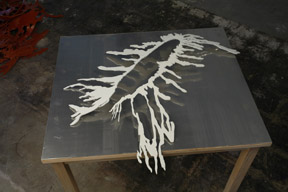
Barbara Zucker, Time Signatures: Around My Mouth,
powder coated steel, aluminum and wood table, 2006.
Since the late 80s most of my sculpture has specifically related to issues of feminism, and of being an older woman in the backlash culture that has evolved. Starting in 1989 I began working on For Beauty’s Sake, in which I commented on the then burgeoning field of cosmetic surgery, and how hard women work to avoid looking old or not blond enough. This series was followed in 1998 by Time Signatures, still ongoing, in which I turn the lace of lines on women’s faces–wrinkles–into abstract patterns that relate to other forms in nature like rivers or topographical maps. In it I try to demonstrate that there is beauty in these lines, that they are not to be effaced or discounted. Many people are repulsed or turned off by this series once they know what it’s about, or they think it is gimmicky or just a one liner. They would prefer that the work remain abstract, claim that it would be more “interesting” that way, unencumbered by its content. These reactions make me sure that I am on the right path.
Barbara Zucker is a sculptor who with Susan Williams, co-founded and exhibited at A.I.R., the first women's cooperative gallery in the U.S. Her work has been shown widely, and is represented in major museums. Zucker has written articles and reviews in such publications as Art News, the Village Voice, Heresies and Art Journal. She is Professor Emerita at the University of Vermont.